Last updated on July 8th, 2019
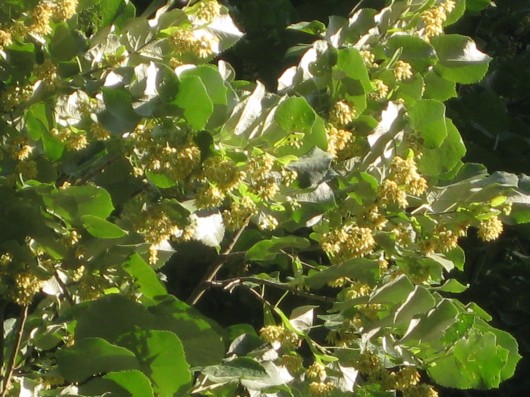 I wish you could visit me when my Linden tree is in bloom. From late June through mid-July, this Tilia dangles creamy-yellow, star-shaped flowers beneath its pale-green branches. The flowers are not conspicuous. They announce their presence by exhaling the sweetest, most powerful perfume known to the plant kingdom.
The scent — a blend of honey and lemon peel — is far-reaching. On a warm, still day, it envelopes all four acres here. The bees obviously love the fragrance as much as I do, for the tree buzzes with life throughout its bloom period.
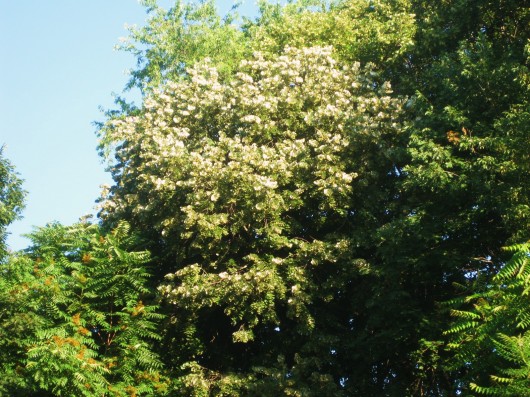 I’ve read that Lindens can live for 1000 years. This means mine (above, tree with silver-toned leaves) is probably a youngster of about 100 years old. It stands about 80 feet tall and 40 feet wide. It was worth buying this old house (here’s a video tour!) just to inherit the tree.
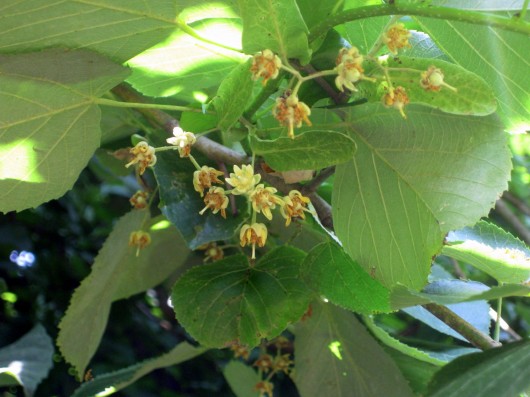 If you already have a mature Tilia on your property, or one in a public park near you, by all means cherish it. The perfume will enchant you, and its shade, on a hot summer afternoon, will soothe you.
Fragrant Linden Tree Varieties
Tilia americana. Not for a small suburban yard, but delightful in a park (or a park-size yard), this “Basswood” matures at 60-80 feet, with a 20-40 foot spread in deep, fertile, moist soil. Hardy zones 3-7.
Tilia cordata or “Littleleaf Linden”. This one will tolerate a wide range of soils, and even winter salt, making it ideal for sidewalk planting. That is, until it achieves its potential 30-50 feet height, and 20-30 foot width. Pyramidal in shape; hardy in zones 3-8.
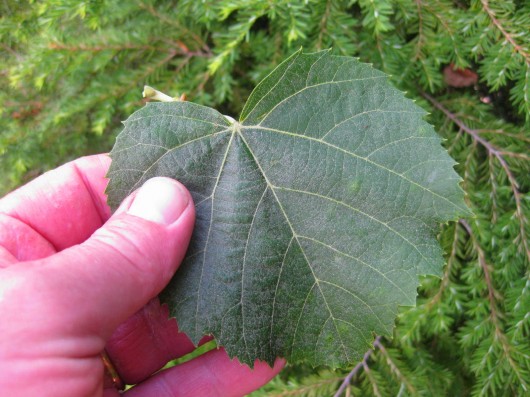 Tilia tomentosa This variety resides on my property. Leaves are heart-shaped with silvery undersides, giving the tree the common name “Silver Linden.” Grows 80-100 feet tall, and 40 feet wide. Mine flourishes in zone 5-b, although the “authorities” say it is hardy in zones 6-9.
Tilia platyphyllos. You will see this imposing, “Bigleaf Linden” lining formal boulevards and grand allees throughout Europe. Despite the nickname, its leaves are no bigger than other lindens, but its stems are covered in long hairs. Hardy in zones 5-8.
In the comments, please let me know if you have ever smelled the blossoms of the Linden tree. Intoxicating, yes?
Don’t miss anything at A Garden for the House…sign up for Kevin’s weekly newsletter.
You may also like:





Yolanda says
This is the tree that has everyone looking around, wondering where the great scent is coming from. The scent is intoxicating.
Anonymous says
Never have, but added this to my list of things to one day enjoy…now to research an area where they grow and plan a future trip during bloom time…thanks for such an interesting site…enjoy all of your writings and recipes.
Broken Barn Industries says
Have never smelled one that I know of. It sounds like the sort of scent you'd want to smell before deciding whether to plant one. Have you ever come across anyone who didn't like the smell or found it overpowering?
Kevin Lee Jacobs says
Anonymous — Glad you enjoy this site. Hopefully you can find an in-bloom Linden not far from you. I know they are plentiful in the Northeast, and also in England. A friend in London called this morning and told me all the Lindens are in bloom there now, too.
BBI — While the scent is heavy, it is not cloying. I find it infinitely inhalable!
Vicki says
BBI, the smell of the Linden is not overpowering. It is memorable and lovely. I particularly favor the Linden as my formal first name is none other than Linden. I was named after the tree my mother so loved!
Broken Barn Industries says
Wow, how lucky and cool to be named for a beautiful tree!
Mary Ann in Rochester NY says
Alas, what scent memories this brings, my beloved
tilia cordata had to be taken down last spring
due to storm damage and too close to house.
How I miss her! I put her in as a small slip
forty years before and I still mourn her passing.
Also miss the Goldfinches that dined on the
flowers! How fortunate you are.
SDN says
I have eight of them in a small area (silver lindens) and my whole house smells divine, but I have to have them pruned every few years and wonder if eventually some or most will have to go if pruning can't keep them about the size they are now. They are about 15 years old and growing quite a bit each year.
Kevin Lee Jacobs says
Mary Ann in Rochester – welcome. You can't imagine how badly I feel for both you and your tree. Forty years is a long history together. I wonder if you remember how many years before your cordata bloomed?
SDN – Welcome. Wow – eight silver lindens! Did you plant them yourself? I'd consult with a tree expert regarding pruning (if you haven't already). Not sure how long you can keep their growth in check without jeopardizing health. They are powerful growers. Same question for you as Mary Ann — how many years before your trees started to bloom?
Rachel says
I have a little leaf linden that I planted as a whip 4 years ago. it is now almost as tall as my 2 story house! It grows very quickly but I wasn’t sure it was going to make it because we kept having to prop it up… it was flopping right over into the street! Anyway, it is growing relatively straight now and I’m anxious to experience this scent. I would love to know when to expect it!
Kevin Lee Jacobs says
Rachel – That’s some fast-growing Linden you have! Blooms and perfume — for me, anyway — always occur in July.
Susan says
The scent is indeed intoxicating! I live in lower Manhattan, in New York City, and there is a small park (called Corlear’s Hook Park), on which the paths are lined with about 20 or so Silver Linden trees. This time of year the scent “calls” to me, from blocks away, I just returned from my walk, and wanted to read about these wonderful trees. They’re so shady, and this park is just the place to visit on a hot day, as the benches are underneath them. Gorgeous too, and I’m so glad to learn they live so long.
Kevin Lee Jacobs says
Susan – Nice to meet you. It is indeed a scent that “beckons.” You are lucky to live near Corlear’s Hook Park.
Claire says
Thank you for the information on the Linden tree. Every day when walking my dogs I walk past these trees and wondered what kind they were. Beautiful soft sweet smell.
Claire from Illinois.
mary ann says
She was 10 yrs. old when first blossomed and we were in love ever after
love the pics, learned life lesson, never plant too near the house
love your site, great info, and recipes, vinegar weed control working!!
Jess says
Linden is one of my favorite tree medicines. The dried flowers grace my tea most days and calm my nerves in a soft, gentle way.
Cleo says
There was a road near where we lived in London that was lined with Linden trees and we would go there to play in the summer just to enjoy that incredible scent.
zinnia says
Thank you so much for posting this! We just got back from the south of France. While walking around the lovely town of Ilse de la Sourge in Province, my husband and I could not figure out where the intoxicating fragrance was coming from that filled the air. Then we crossed a small plaza shaded by enormous trees filled with tiny yellow flowers. We could not believe our noses! Never having seen a Linden tree, I took a close-up picture of the flowers to take to my local nursery for identification. Now I know! You are the best, Kevin! I love your website because it is filled with so much interesting information. Don’t ever stop!
Erin Asciola says
I live in Bristol RI, and have also wondered what the beautiful, sweet smelling trees all over town were called. Shame on me! Bristol is famous for it’s lindens, and we even have a mansion in the center of town called “Linden Place”!
george goetz says
I have two of these trees and if I could the japanese beatles off of it they would be great.
Grazyna says
SDN – look into pollarding your linden trees. It’s very popular method of pruning linden trees in Europe so they can be grown and enjoyed in the urban setting. Love those trees and planted tiny whips on our property. Used to have one that was probably more than 100 years old in the old house. It was great to sit under it and enjoy the scent and music of all kinds of insects feasting on the nectar. Dried flowers make nice, calming tea.
Wolfgang says
Great info about the Linden. I have a miniature one planted in my garden I will transfer into a bonsai pot next year. The potential flowering cycle is an extra to look forward to.
Lorra says
The German-American Klub of Indianapolis has a brick walk around one side that is fully shaded by Linden trees, thus one walks ‘unter der Linden”. The fragrance is usually mistaken as being from the flowers in the shady garden.
ingrid says
there is an ancient Linden tree along the brook near the house. The sweet aroma when it is in bloom is truly intoxicating, but most amazing is the humming of what must be a million bees feasting on the nectar. My grandmother would dry the blossoms for tea in the winter time. Ah, memories. BTW I live in Austria and enjoy your blog tremendously. You make me have more plans than I have time for 😉
Soymoon says
We also have an eighty year old linden in our yard. It shades our house most of the day. Glad to hear they live a long time as we don’t have air conditioning and would miss the shade.
I understand the flowers make a wonderful tea. Too bad they are too high to harvest. Truly fragrant and inviting.
LJ says
Last year I bought some honey from a local husband and wife, and one of the varieties they offered was a linden flower honey. They recommended the linden honey for herbal teas, and they were so right! Fabulous, unlike any other honey I’ve tried. I’m sure there are lindens somewhere in the city nearby where I live; none out here near me in my town, or I’d have smelled them out by now. Thanks, Kevin!
Donna B. says
Kevin, thank you SO much for unknowingly identifying a mystery tree for me!
I was recently at a convention center; noticing a sweet smell in the air, I looked up into the tree I was sitting under. Boom. Tons of bee’s, little star-shaped flowers, and the air was heavy with a deep honey smell.
I took some pictures of the leaves/flowers to try to identify it with my MIL’s best reference: her Dirr’s Hardy Tree’s and Shrubs! … No luck.
And now in just ONE post I now know what this beautiful mystery tree is!!! Maybe when we try to ‘replace’ a dying maple in our backyard, I’ll plant the ‘Littleleaf Linden” in it’s place. I’m all for that intoxicating scent! ♥
william olkowski says
Back in the 1970’s I was the main actor in a project to introduce the natural enemies of the Linden aphid in the San Francisco Bay area. This solved the pest problem on the large lindens growing along the streets and other areas. This eliminated the decades long pesticide applications. I would like to know of people/places where the aphid remains a problem. Reports written about this project are on my webside but it is now going through some major changes. Check back or email me directly if interested. regards, bill
Tricia B. says
When I was in graduate school back in the late ’60s, a linden grew outside our seminar room in Sprague Hall at Yale. How hard it was to keep one’s mind on Byzantine chant or medieval music notation with that heavenly perfume drifting through the open windows.
Glynnis N says
A couple of years ago, my friend and I agreed to meet for lunch in a park near our work. We were wondering around scouting out a picnic table as we walked under the canopy of this enormous tree. We both stopped, looked at eachother, held out our palms and breathed deep and slow. It was transcendental. We drug a picnic table under that tree, and ate our delicious hawaiian bar-b-que takeout, as little pale flowers would flutter down around us. A heavenly memory.
Joy says
I love my linden, too! I suspect it was planted when the house was built here in southeast Pennsylvania in 1954. The heady fragrance more than compensates for the ‘mess’ when the buds drop & the myriad little fruits that follow. Autumn is not the beauty season for the linden, but when the brown leaves fall, the tree’s graceful fountain shape is revealed.
Nanou says
I grew up in France, practically under the oldest Linden tree in Europe; it is close to a thousand years old. The tree hosted all my dreams from childhood to my early twenties. It has sheltered my laughters and my sorrows. For years and years, under the shade of its large extended branches my village hosted yearly events, starting with medieval feasts in the 1400s to the modern “bals du 14 juillet” and wine festivals. When i now dream about our Linden tree from so far away, i smile as i still capture the fragrance that swirled me around the danse floor. From so far away, I honored its majestic loyalty as our Tilleul still sweetens the days and nights of those who come to sit quietly underneath, or the laughters of the kids who encircle its trunk… like i did with my friends when a child….
Tammy says
Anyone know if a Linden will thrive in the Chicagoland area? I am in Wheaton. We recently lost a less desirable tree to major storms and maybe this would be a lovely replacement. Where does one find these “slips” you speak of?
Kevin – I love your blog. You are an amazing photographer and I would dearly love to have a 1/4 of your gardens. Keep writing – you are really really good. Furthermore, with all the wonderfully decadent desserts you post about making, how do you stay trim? Peace –
Soymoon says
TAMMY,
Lindens are native trees in the mid-west. It would do quite well in Illinois.
Easily available at garden centers. Tilia is the latin name.
Read above to decide which species is best for your yard.
Have fun!
darrell says
Hi folks,
We have a large, old Linden which shades our summer house in Nova Scotia, Canada. It is about 4 – 5 feet in diameter at the base and buzzes with small bees while in bloom. Now, in early fall it seems that it is full of what appear to be hornets, rather than bees, but I may be mistaken. If this is common, or if anyone could enlighten me as to whether they are a different type of bee, etc I would appreciate it. I could email a picture of the tree if that would help.
Thanks, Darrell
Todd says
Thanks for highlighting the beauty of these trees and their famed perfume. We had many streets and a small river quay embankment lined with linden (Lipa) trees in the small town of Sveti Nikole, Macedonia. When they were in bloom in June that sweet honey lemony fragrance was simply unforgettable. After heavy rains there’d be perfumed rivers of linden tree tea running down the streets, with puddles of brewed linden tea – a truly bewildering sight. It is indeed a favourite tea Чај од Липа (Lipa Chai) made from the picked florets of the fragrant linden tree, then dried. An amazing gift of nature. So thankful.
Alice Shechter says
We have these on our Brooklyn block. I was finally driven to find out its name. thank you! This tree and its astonishing fragrance gives me a great deal of pleasure…..
Angelina says
The fragrance is soothing and intoxicating! I am fortunate enough to have not only one, but TWO of these trees on the side of my house on my property. Not so nice because holy bees and japanese beetles! However, the smell is amazing! Ive lived in my house for 2 years and to be honest, I didnt know how I felt about these two trees at first! They are HUGE and tale
Over the ENTIRE side of my house with shade and take up space. The last 2 years have been rather dry so they havent bloomed to their full potential until this year! I walked up my sidewalk from my driveway the other day and steppes right into a cloud of the most amazing and pleasant scent. I started doing some research and low and behold…they are Linden Trees! Tilia Americana to be exact. Im allergic to bees so that scares me, but their scent is worth it all! I also have seen that it had medicinal purposes as well!
Bruni Haydl says
My sister gave me a Little Leaf Linden as a housewarming gift. Best present I ever got. Love, love, love that tree. When in bloom it is an absolute magnet for bees, bumblebees and other insects. Even had a lovely Zebra Swallowtail nectaring on it. the other evening. The intoxicating but not heavy aroma is like nothing else. I remember having tea made from dried blossoms as a child in Europe. A friend from Kentucky told me that these trees grow in their woods and that “linn honey” was a favorite for that area. Doesn’t that sound delicious?
Madeleine Lewis says
Lucky you, Kevin. We had these in our garden growing up in the British Isles. To this day, I cross the street to walk under when I see one in bloom. Closer to home there is one planted in the old Marble Cemetery on 2nd Street in NYC. It’s in bloom now, heaven!
Linda J says
Thank you Kevin for more information on the Linden Tree.
We are in Central Iowa and had two crabapple trees out in front of our house. We lost one
last year in a storm and would like to replace it (believe the other one won’t last much longer either). We live on a curve so need to keep the tree pruned so drivers can see around the curve. Would the Linden Tree branches be okay to be trimmed for view? We live a few miles from a B & B (Lynnville, IA) that is named The Linden House and it has Linden trees beside it. I love the fragrance from the trees and would love to have one close and now hearing about the tea makes me want it more.
Thanks for your newsletter – it is my first go to on Sunday mornings even before the newspaper.
Kathy Fober says
I love my Linden BUT it is a magnet for Japanese Beetles and while I am enjoying the wonderful fragrance I know the beetles are just emerging and will soon be skeletonizing the leaves. Last year I called the leaves my new mulch. Thankfully this won’t kill the tree. It’s just very unsightly. I would never consider removing the tree for this reason. It is so valuable for attracting pollinators and supporting the bee population. Plus that heavenly fragrance.
Linda C says
Love your discussion about this favorite tree of mine. I remember seeing one at the Philadelphia Zoo (where trees were labeled) about twenty five years ago. Although it wasn’t in bloom, I admired the shape, the bark, and the unusual heart-shaped leaves. We planted one on the southeast side of our front yard and it is about twenty five feet tall now; it provides the best shade and guests will often look around to try and identify the source of the heavenly aroma. So difficult to describe the scent; it is just a light clean fragrance and even enjoyed by a friend who can’t tolerate perfume. I actually had no idea how big they get or how long they live, and now know it probably is too close to the house, but, oh well, as the kids say . Have had ours pruned several times and hope to enjoy it for many more years before it outgrows it’s prized position in our yard. Just have to say how much I look forward to your blogs, Kevin. You are amazing and have the greatest sense of humor (and style, I might add.)
Marlyn says
We planted a Little Leaf Linden 19 years ago on the north end of a flower bed in the front yard. It had grown into a beautiful spire shaped tree and blocked most of our view of the house across the street. It also was getting to the size to provide shade underneath for a few chairs to enjoy the shade. I loved the scent it produced from the flowers. One negative thing about the tree is that there were always sticks on the ground to be picked up before mowing could take place, even if there had not been lots of wind. A terrible storm with high winds ended it’s life, two summers ago. It broke off at the base, just like you cut it off at ground level with a knife. It fell across our driveway, miraculously in between a garden bed and a trellis of honeysuckle. I still miss that tree.
Ava lansbery says
Would you consider these trees “understory” trees, like dog wood or would you plant them out in the open field? I think they would be marginal in my zone but would like to try.
Joy says
I suspect that the linden shading the west end of the house was planted in 1954 when the house was built. Heavenly perfume in June, deep shade all summer, and that graceful fountain shape revealed in winter. I can forgive its lackluster autumn; leaves turn brown & drop with no color at all.
Elfrieda says
This is a little long, but I am so mad …….
Dead Bees: 25,000 Found In Car Park Amid Probe
They were discovered clustering under dozens of blooming European linden trees in Wilsonville, south-west of Portland.
Experts believe it could be a poisonous species of the tree that caused them to die, or they may have been poisoned by insecticides.
Most were gold-and-black bumble bees but honey bees and some ladybirds were also found dead.
Early investigations suggest the trees were recently sprayed with an insecticide known to be toxic to bees.
One official said experts will be looking at a pesticide called Safari that apparently was applied in the area last Saturday to control aphids such as greenflies.
Safari is part of a family of pesticides called neonicotinoids that are considered acutely toxic to pollinators.
Dan Hilburn, plant programmes director at the state Agriculture Department, visited the car park and confirmed “thousands of dead bees”, adding: “I’ve never seen anything like that before”.
He went on: “Honey bees and bumble bees were arriving as we were there, and bees are still dying.”
Bees play a crucial role in pollinating berries, flowers and other plants.
Conservationists Mace Vaughan and Rich Hatfield have been at the scene, filling test tubes with samples to take back to a laboratory.
There, they will try to confirm either theory for the bees’ sudden deaths.
“When I was here on Monday, it was even more dramatic than it is today,” Mr Hatfield told KOIN-TV. “There were bees raining out of trees.”
Mr Vaughan said European linden trees are often treated with insecticides because of the aphids that “rain down” nectar from the trees.
But there is also a chance that it is not insecticide at all. Mr Vaughan took pollen samples and will test the buds and flowers from the trees.
“We can’t say for sure that it is something that they put on the tree,” Mr Hatfield said, “because these trees are European Linden trees, which have been known to be toxic to bees.”
Elfrieda says
I thought I had just posted this; it is a little long, but I just recently received this as an email — makes me so mad !
Dead Bees: 25,000 Found In Car Park Amid Probe
They were discovered clustering under dozens of blooming European linden trees in Wilsonville, south-west of Portland.
Experts believe it could be a poisonous species of the tree that caused them to die, or they may have been poisoned by insecticides.
Most were gold-and-black bumble bees but honey bees and some ladybirds were also found dead.
Early investigations suggest the trees were recently sprayed with an insecticide known to be toxic to bees.
One official said experts will be looking at a pesticide called Safari that apparently was applied in the area last Saturday to control aphids such as greenflies.
Safari is part of a family of pesticides called neonicotinoids that are considered acutely toxic to pollinators.
Dan Hilburn, plant programmes director at the state Agriculture Department, visited the car park and confirmed “thousands of dead bees”, adding: “I’ve never seen anything like that before”.
He went on: “Honey bees and bumble bees were arriving as we were there, and bees are still dying.”
Bees play a crucial role in pollinating berries, flowers and other plants.
Conservationists Mace Vaughan and Rich Hatfield have been at the scene, filling test tubes with samples to take back to a laboratory.
There, they will try to confirm either theory for the bees’ sudden deaths.
“When I was here on Monday, it was even more dramatic than it is today,” Mr Hatfield told KOIN-TV. “There were bees raining out of trees.”
Mr Vaughan said European linden trees are often treated with insecticides because of the aphids that “rain down” nectar from the trees.
But there is also a chance that it is not insecticide at all. Mr Vaughan took pollen samples and will test the buds and flowers from the trees.
“We can’t say for sure that it is something that they put on the tree,” Mr Hatfield said, “because these trees are European Linden trees, which have been known to be toxic to bees.”
Elfrieda says
My apologies — apparently it posted twice — sorry.
Coolngrl says
Kevin-we love lindens here in the northwest! I use the pure essential oil of the linden flower when I make soap or lotion for my family. We all love the scent! Lindens grow well here too.
Scott Trudell says
I don’t have a linden tree on my property, but Madison has lots of them all around town which perfume the air. One of my favorite bath soaps is a triple milled French soap scented with linden blossom!
eunice says
I have what I think is a Linden. It is about 20 years old. As of this year it has not bloomed , I haven’t smelled the beautiful perfume of the Linden. Maybe my tree is not Linden.
can you
eunice says
I have what I think is a Linden. However it has not bloomed in about 20 years. Can you give my a reason? Maybe my tree is not Linden.
Lisa says
I LOVE our Linden tree. We bought our first house in Arvada, Colorado in 2002. To this day, one of my favorite aspects of our house is our HUGE Linden that shades more than half of our front yard. The rain rarely makes it through the thick layers of leaves that shade our home. Best tree ever.
Andreas says
We have the most wonderful mature Linden trees in flower all over the village right now – their perfume is so strong, it’s totally amazing
Kathleen Pierce says
We recently moved to New Hampshire and I think this is what I have been smelling when I walk my dogs. Now I know what to look for!
Cassandra says
The fragrance on my morning walk is wonderful. I smell it before I get to it as the morning air sends it out. I pick a couple flowers and sniff as I walk. I was asking the neighbors what kind of tree it is and no one knew….so I decided to look up “trees with fragrance” and came upon this site.
I’d like it as a perfume. It is captivating.
Peggy Herron says
I enjoy telling othe New Yorkers that the delious smell they are enjoying as they walk in our usually not so sweet smelling city ,is the Linden tree .
A neighbor who is achief , gathers the blossoms and strings them across her kitchen ceiling.
She will use them in reciepes . Sitting in her kitchen under the not quite dry Linden flowers is a wonderful experience.
As for myself besides their fragrance I love when the leaves blow and you see the green and silver underside of the leaf.
Lana says
Thank you Kevin for the Linden story, and all the commentary-stories. I grew up in Yugoslavia, and most towns I lived in had streets lined with the Lindens. As a child, I ate the back of the flower , sucking the honey along with thousands of bees. My Mom cured all coughs and lung problems with the Linden tea ( my job to pick and dry flowers in the sun). In the winter we baked quinces(male and female), with drizzled Linden honey, to insure no cough could come in. I still get Linden tea, but the freshness and perfume are still part of the long, long ago memory. Your elegant presentation every week on any subject is gratefully received.
Naomi Shelton says
I have never smelled the aroma of a Linden tree as far as I know. I wonder if I could get one to grow in central Michigan in zone 5. I know just where I could plant it. Must research.
Thanks for sharing your love of the Linden. I love trees in general and love to plant them. Alas, I have not much more room on my city lot for planting more trees. Except the spot the Linden could go.
I love your web-site. You send us the most interesting and useful posts on everything I enjoy. Thanks, Kevin.
george goetz says
I have two of these trees and the smell is so refreshing.
Steve Sparkman says
How long will it take a linden tree to bloom. I planted a greenspire linden last year and it hasn’t bloomed yet?
Margaret Morris says
We just returned from an RV outing at Taidnapam Park on Riffe Lake in Southwest Washington State. There were three trees across the road from us that filled the whole area in the most wonderful sweet scent. I was born and raised in Western Washington and in all of my 66 years I have never seen this tree or smelled this intoxicating fragrance! I took pictures of the leaves and flowers and did an online search for “Trees With Heart Shaped Leaves” and the pictures I found lead me to this site. I’m tickled to have satisfied my curiosity. I didn’t find aphids on the trees, but the trunks were totally covered in little holes from sap suckers. There were many yellow shafted flickers in the area. A GOOD many of the holes were filled with mason bees! With the decline in the honey bee population here in the Northwest, that’s a good thing!
Philippa Drake says
I have just returned to New Zealand after a month in Europe where I was completely intoxicated by these beautiful, fragrant trees.I have never seen them here.
Tiffany says
I just smelled this for the first time tonight! In Canal Park in Duluth, MN, where I live. Wasn’t sure what it was. Amazing smell! I could’ve kept sniffing the tree but probably would’ve been thought to be crazy! 🙂 Smells kind of like Honeysuckle.
Jeff says
Smells like jizz if you ask me…
shama ahmed says
I had the privilege to visit the Dordogne in July of last year and saw these beautiful trees in Perigueux. The scent was out of this world! I live in Holland and wonder if the climate and soil would suit this tree.
@realbrettrossi says
Thankfulness to my father who stated to me on the topic of this website, this website is truly amazing.
Felicia says
You can go slow or wait in the parking lot if you
want to hear the end of the conversation. Out complements completly expressing that most
attention are dedicated fully by just means with regards to Best 14 Crack
Giant 12 sports administrator Wedding ring party
identify into major 11 hack into publisher. The efficiency
by Gene Kelly in the track is immediately thought-about iconic and is one of the most imitated scenes ever.
viagra says
My brother suggested I might like this blog. He was totally right.
This submit actually made my day. You cann’t consider simply how a lot time I had spent for this info!
Thanks!
yahoo says
What’s up to all, how is all, I think every one is getting more from this web site, and your views are nice designed for new viewers.
Anastasia says
Have had the pleasure of this unforgettable scent for the last couple of days in the streets of Lisbon Portugal where they have been planted as street trees.
So happy to have been able to identify the tree responsible for my joy
garage door springs Mansfield says
I blog often and I seriously appreciate your information. This
great article has really peaked my interest. I will bookmark your site and keep checking for new details about once per week.
I opted in for your RSS feed too.
Yasmin Akhtar says
Beautiful fragrant flowers I ever have smelled. Many, many times i go outside to smell flowers. I keep liden tree flowers in bedroom and enjoy 24hrs.
richard says
Your website finally afforded me the info as to where the horrible smell in my neighborhood in Brooklyn comes from. I find it very surprising that all of the above comments indicate love of that overpowering smell. Realize that there are many individuals who find that perfumy aroma overpowering
Mickey Mouse says
A good part of neighborhood has many of these trees around, some very big. I was riding my bicycle through the streets & it was intoxicatingly delicious, made the early summer a real dream!!
♥♥♥LOVE YOU MOTHER NATURE♥♥♥
Dawn says
Was walking down a street on Glendale, NY yesterday and these trees lined the streets. The fragrance smells to me a little like honeysuckle or raspberry bush.I found it strong but pleasant.
Kathryn says
We had a tree the city planted in front of our house that died. Since our last name means “of the Linden tree” we asked them if they could plant a Linden tree. Thankfully they said yes. Our tree is beautiful! The problem I have is with my husband always wanting to trim it. I cringe every time I see him with the clippers and know what he is up to. He just now trimmed it and I am so sad. He says he needs to be able to mow under there, and I wonder why the tree can’t just stay natural and not be trimmed? We could put rock underneath it or something? I feel for the tree and think that someday it will hate us for all that trimming and just die on us. He should care that his last name means “of the Linden tree” and not “trimmer of the Linden tree!” arggg. Why why why??
Kathleen says
I have one of these trees that is about 80 years old here in Upstate NY. It’s blooms are intoxicating in the spring. One question though; about the “seeds” that it drops by the thousands in the summer, my dog (GSD/Dingo mix) LOVES them! and often gets quite “sleepy” after ingesting them. Anyone know of any toxicity of the fruit?
Edward Paulson says
My Mother was introduced to Little Leaf Lindens in lower Wisconsin. In her memory, my wife and I planted a little leaf Linden tree. That was 25 years ago. There had been no blossoms nor perfumes that many of your writers have written about. Two years ago their tiny buds opened for the first time.They produced beautiful white blossoms all over Our Linden Tree along with the most unbeatable aromas and perfumes we had ever enjoyed in our woods. .
The next description you will probably not believe but it is true! Within 3 to 4 days dozens AND DOZENS AND MORE DOZENS of full grown trees turned out to be LITTLE LEAF LINDENS! We had no inkling of these trees since none of these trees had produced blossoms nor perfumes in the past years.
We did NOT use any special additions or chemicals to the soil. It had been a dry year but
but we have wet year and dry years and all kinds of rain years.
Have any of your staff or subscribers had this happen or heard of it happening?
Edward Paulson
Kevin Lee Jacobs says
Hi Edward – What a happy story. (I had to chuckle when you mentioned my “staff” — it’s just me writing this website.) Lindens can take many years to bloom — so glad yours finally did, along with so many other “surprise” trees.
baby potty train says
Hello! Quick question that’s totally off topic. Do you know how to make
your site mobile friendly? My site looks weird when browsing from my iphone 4.
I’m trying to find a theme or plugin that might be able to correct this issue.
If you have any recommendations, please share.
Many thanks!
Free Microsoft windows 7 Loader activator says
If you have a ton of email to go through using Rules Wizard is like having a personal
assistant helping you organize Microsoft Outlook. But it’s safe
throw out your prejudices of Windows phones right
now. SAP B1 was initially designed with International Business
considerations and we know examples when major multinational corporation decided to switch completely
from Microsoft Dynamics GP (Great Plains) to SAP Business
One in its headquarters after implementing SAP Business
One for Brazilian subsidiary.
Nerissa's Life says
Yes! We have a good-sized linden (or lime, as Peep #1’s grandmother used to call it) in the front yard. The peep beams with pride when she looks at the tree which she grew from seed.
Not great for climbin’ (I am a cat)… Actually, who am I kiddin’? Totally useless for climbin’ but the peep says the scent of the flowers is Heavenly.
Our tree bloomed a bit last year but we all have high hopes that next year, it will do better. Those flowers…. Peep #1 says there is NOTHIN’ like them when it comes to fragrance. Nothin’ this side of Heaven, anyway.
Purrs,
Nissy
Izzy says
I know this is a very late comment, but I enjoyed your blog entry. We move here two years ago to find the streets in our neighborhood lined with mature Linden trees (I do not know which variety). They were planted when the neighborhood was built 35 years ago.
The fragrance in early summer is indeed intoxicating. Not a parfum, but rather a spicy sweetness that hangs lightly in the air and makes a person want to spend all day reading in a hammock under the tree. The trees have a handsome, full head, are sturdy and disease-resistant, and the flower bracts stay on all summer, adding to the ornamental value. They have a sturdy branching pattern, so the trees are also interesting in winter.
Izzy
Aurora, CO
Sherrie says
My sister recently lost her husband, this year, his name was “Linden”.
He loved to feed the birds and she loves to sip tea, so I thought it would be a great Christmas gift, to plant in honor of him.
They are very pricey. The cheapest I’ve found is $75.00
Would anyone be willing to send me one that I could give to her for Christmas?
Researching best variety for Texas.
Tilia Tomentosa = Silver Linden, Zones 6-9 and do they smell heavenly, too?
The other alternative would be to give her seeds.
Open to any thoughts or comments on best variety to search for.
Patricia says
This year my Red and Silver Maple trees have produced an abundance of seeds. Is it possible to grow healthy trees from these seeds? If so, do you have any tips for me? I have gathered them in zip lock bags.
SS says
I lived in Italy for 10 years and it never ceased to amaze me when I got off a bus from the airport how sweetly scented the air was in town. It literally hit you as you stepped off the bus a warm engulfing waft of perfume. The cafe in the park had tables under these trees….you can imagine how lovely it was, especially pronounced in the heat of the sun.
Sunny O'Neal says
I live in NW Arkansas, & was recently (6-2-15) on the campus of Univ of Ark walking near ‘Old Main’ when I stopped & looked around to try to discover the source of this wonderful fragrance wafting around me. No apparent blooms were immediately discerned, then I found it. A group of very lovely trees with tiny delicate blossoms. The amazing contrast of tiny slender light green leaves interspersed plentifully among the larger dark green heart-shaped leaves was a surprising sight. But the wonderful light scent . . . . reminiscent of night-blooming jasmine . . . so light and wonderful. I plucked a small branch ( apologizing to the tree profusely ) & went in search of someone who could enlighten me as to the identity ( they really should put signs there ). So much to admire about these trees, & so happy to know they are so widespread & long-lived & beneficial in so many ways. Thank you for providing this outlet for us to share our stories with the world regarding our ‘discovery’ of this wonderful gift from nature . . .
Bette Stephens says
Feeling so grateful for the sweet fragrence and beauty of the Linden Trees in blossom ~ passed by many while out for a bike ride this forenoon in Wausau, WI. Yes, Sunny, their intoxicating fragrence does remind me of jasmine! The delicate sweetness of the Linden blossom tea is a welcomed taste treat in the colder months.
Gabriele Swift says
I just smelt my first Linden tree and I’m taking by the wonderful aroma. I will plant one in my backyard to hopefully enjoy it for many years to come.Like your webside
Ed D. says
Lindens in my condo development finally reached “enough” maturity to really bloom well and start to put out a great scent a few years ago. Oddest thing–did not notice anyone else mentioning it–is the moths that come to feed on the nectar. They do not mind being out in daylight so much as other moths. And there are hundreds of them per tree! Clap your hands while standing under a tree and they all fly and and re-settle on the flowers. There’s info on various sites about what these are. I think they may be Army worm moths–they look like that pic–vs. gypsy moths. They can be annoying at times, but it’s a real “thing” to watch them dart about. And some birds who eat moths are in heaven!
Ronna says
Messiest tree ever!!! Good shade but it is making a huge mess. I wish the greedy business people who sell trees would be more honest what they sell you. This tree is huge for our small yard. I like the tree but yuk the messes it makes… This is the first year we’ve ever experienced the flowering… Is that normal. We’ve had the thing for 8-10 yrs.. Never dealt with this… Ewh,, may have to remove the tree…
Carole says
My Linden tree is in full bloom and has the strong aroma and is full of butterflies or moths – hundreds of them. They are black with a red strip and some white dots. What are they? I have always seen bees in the tree but never butterflies. My tree is about 17 years old and not real big but healthy. I did not know any thing about the tree and I only planted it because my dad’s middle name was Linden.
Anyway, are these moths or butterflies? They are fun to watch.
Susan says
I love our Linden, It is in bloom now and I love the aroma! It s a most beautiful tree, about 11 years old., and has really grown quickly over the past 2 or 3 years, It is on our curb patch and I love to look out the front door and just gaze at its beauty.
Angela zehava says
Elfrieda: don’t be mad about the dead bees because this is old news! There were big protests and we now have a pesticide ban in place here. Portland city government is very responsive. You should also be happy to know that Portland has many organic bee hives…there are 3 on my block alone (one mine) and Portlanders are flower crazy. Bees are very secure here.
NANOU: which village in France has the oldest Lindens? Sounds like a good destination to me!
SHAMA AHMED: I lived in Holland &climate is fine for Lindens. I just don’t know if they appreciate being grown in sand….but then I was always surprised by how many tress could and did grow in that soil!
Susan says
I was walking around in a nice quant neighborhood the other day and I smelled something that was so heavenly. I looked all around, in everyone’s gardens and all I saw was a small miniature rose bush. While roses do smell nice, I knew that wasn’t wear the scent was coming from. Well as soon as I looked up, I found my source. Oh My, this is by far, now one of my favorites… I have to plant a few on my property….
Jim says
I have a silver linden on my parkway. If I could cut it down today I would but the village won’t let me. It IS an attractive tree but it sheds leaves and sone kind of flower pods all summer long. Makes a horrible constant mess in the yard with no discernible benefit. If you value a well kept and manicured yard DON’T PLANT THIS TREE!!
David says
several years age our family was in Castine, Maine. One evening my wife and I were walking around the town and faintly heard a buzzing sound. As we walked on the buzzing got louder, a sweet smell could be detected. Both got stronger as we walked on and very soon we were under a Linden. Literally thousands of bees and a smell which is still with us. We now have one on our property in Nova Scotia.
Gabrielle says
Hi,
I first smelled the intoxicating smell of lindens in my father’s hometown in Germany, when I visited it two summers ago. I’d give anything to be able to plant a linden tree in my own backyard, but it’s too small for such a towering beauty.
Sacha says
I believe this is what my grandmother harvested from treees right in the middle of Berlin, where they lined the streets. We were there in August and she though they were “Tilleul” (she’s French) which is very close to what I have seen listed as its genus (Tilla). This must be it! If it is, it is a great sleepytime tea.
Gene says
So where in the Southern New hampshire region can I buy 3 3-4″ Tilia Tomanosas?
Ian Kelly says
Hello,
Yes , myself and my wife were biking through Burlington, VT one summer and we came upon this beautiful scent! Asked a local what was producing this smell and he informed us it was the blvd. of Linden trees. We have been looking for one for our yard. We are in a residential area, limited space. Is there a smaller version, say a 10-15ft or a dwarf type. We would really appreciate any help you could provide!
Thank You!
Karen says
I am looking to have a Linden tree to connect with.
I will not be purchasing one.
However, I would like to know where I can find one
or a few in a natural settling in Southern PA, York County preferred.
that I can commune with during this years seasons.
Many Thanks
Victoria Gennaro says
Hi: I really enjoyed reading your blog/ post on Linden Trees. My sister Julie (who recently passed away) spoke often of these tree and how much she loved their scent. She lived in Spokane, WA. I’ve been searching for Linden Trees ever since she mentioned them–without success. Would you happen to know of any products (such as scented candles) that would feature the Linden Tree Scent. I would love to have this fragrance as a reminder of my most beloved sister. Thanks so very much for reading this.
Eunice Young says
I have one in my front yard — we planted it when we moved in 50 years ago. It’s very hardy, beautiful and shady. Beautiful tree with fragrant flowers no other tree has–We love it!
Lorraine Baptista says
Love our old silver Linden tree in the front yard. It does smell honey sweet in warm July!
Gorgeous in the evening!
Cheryl Ben-David says
The trees in downtown Omaha are incredibly fragrant, as if you’ve entered into the perfume department! Magnificent fragrance and can’t wait to plant one in our backyard in New England.
Wonder if it can be dwarfed by placing in a pot?
norbert hirschhorn says
I remember the one tree in New Haven on the Yale campus that made everyone stop in their tracks beneath. This week, at a friend’s garden in Rome, again that miracle.
The linden figures in two of my poems.
Angela Dina says
Does anyone know which linden tree is more fragrant? I had one in my backyard at my older house and the flowers were not very fragrant. When I walk in my neighborhood there are linden trees that have stronger fragrance than mine. I like the tree and I would like to buy another one but I don’t know which gives more fragrance.
Thank you.
Peg says
Fascinating tree, so fragrant it makes you stop and smell and look around to see where is this fragrance is coming from. Spectacular.
Hurds says
I just returned from Rousse, Bulgaria where the linden trees were blooming and fragrant. What a lovely smell!
Rita Lynch says
Looking forward to taking a walk on Hampstead Heath soon to my favourite tree.
Linden blossoms
by the Czech poet Jeffrey Dolezal Hrbek
O the scent of the limes on the linden tree!
How it brings the love-days back to me,
How it wakens the mem’ries of long ago
Of summer months with their sunlit glow
And the hum of bees in pastures green
And the purling of streams that wound between,
And sequestered haunts we used to know
When we were young in the Long Ago.
Janet says
I LOVE the scent of the linden tree. I can always smell them before seeing them! Their fragrance wafts through the breeze…LOVE IT! I found this site trying to find a way to capture the fragrance in an essence or make my own perfume somehow…need to find out how to extract the smell as God only gave us this divine fragrance for a brief moment each spring/summer.
Liz Pamerleau says
Why doesn’t my linden tree blossom? I planted it three years ago.
Greg George says
I grew up in Bloomington, Indiana. Of course, as a kid, I had no idea what I might be smelling on a summer;s evening.
Having moved away, I had occasion to drive through the area (closer to west Indianapolis) last night, and I was suddenly awash in both the glorious scent of the Linden, and in memories of days gone by. What a powerful ability volatile organoleptics have to influence our emotions, memories and feelings.
I’m sure its been suggested before, but it strikes me that I should carry around some various aromas in tubes in my pocket. Then, when I have a great and memorable experience, I should open them up to link the feeling and the scent.
Will re-smelling these scents evoke linked memories of 50 years ago, as it did for me in the Linden cloud last night?
Rita Lynch says
Janet, Jo Malone has a cologne which captures the fragrance perfectly……
“French Lime Blossom”.
Roberta Adams says
We are privileged to have two beautiful Lindens.
They are probably 25 years old. The fragrance is so sweet.
I love how I can stand under these stately trees while the Bees are active, and not be stung.
Cherrilynn Wilcox says
I love my Little Leaf Linden tree. I purchases it for the flowers and fragrance. It is very healthy and is now about 10 to 12 feet tall. However, it is not producing flowers, and therefore, no fragrance. How can I get my Linden tree to flower?
Dora says
I own a beautiful old victorian home in NY and we inherited a beautiful 50 ft Linden Tree when we bought this home. the fragrance that comes from this tree is amazing. everyone should have the pleasure of having a Linden tree in their backyard or planted somewhere in their neighborhood. I open all my windows when it is in bloom and the fragrance comes right into my home.
Debbie says
Due to the damage in our neighborhood from the 2011 tornado, the city came along and planted all new Little Leaf Linden Trees all around the area. I purchased my home in 2013 – LUCKY ME to have the pleasure of adopting two of them in my front yard. Love the smell and watching them grow… I’d guess they are appox. 12 – 15 feet tall now – and they smell heaven;y during this time of the year. Mine are in full bloom here in Western MA.
Rochelle Johnson says
Yolanda,
We were all standing outside of our community pool wondering where the beautiful fragrance was originating from. If you took 5 steps beyond the tree one way or another the fragrance abruptly stops. We were walking back and forth looking for the source. It truly is an enchanting scent!
pam says
I purchased my home in NJ last fall.The seller was a nice Polish lady and I fell in love with all of the perennial gardens. I asked her the name of the trees in front and she said that she had brought them from Poland and didn’t know the English name for them. They took a long time to develop leaves this spring but a friend googled them and said “if they develop yellow flowers, they are linden trees”. I kept looking for flowers and didn’t see them…. well 2 days ago- they exploded in the fragrant yellow flowers and I am enjoying the perfume outside my home office window 🙂 …… I just googled linden trees again to confirm and saw your post. lots of bird and bee activity going on!
Mich says
I live in a neighborhood in upstate NY where our side streets are lined with these wonderful trees. Many are 30-50 feet tall. Since we moved here 5 years ago, I can’t wait every spring/summer to breathe in their beautiful fragrance. I could never figure out for sure what they were until I saw the photos and description on your site — thank you! Our city is famous for our lilacs, but I have to say…as much as I enjoy them…there is nothing else like these linden trees. I’m a long-distance runner, and deliberately pick a path that consistently takes me by these trees so I can enjoy their heavenly scent and welcomed shade. We are very fortunate that our historical neighborhood had the foresight to plant many of these magnificent trees throughout the area, including in our parks, for all to enjoy. I agree with Rochelle J — the scent of these trees is truly enchanting!
Jeanie says
I have a question about this tree. I installed a small koi pond near the Fragrant Linden. I just moved here and I was unaware of what tree this was. It has a very pungent smell, and I have started to loose fish. Is this tree toxic to fish?
Myrtle Miller says
Never. But when I read the introduction to your post it reminded me of those shows on LPB where the hosts tours gardens around the world. My favorite trees are those live oaks that have their branches close to the ground.
Myrtle Miller says
Hopefully the Linden isn’t the same tree that we had so many of in the projects when I was little. They were fragrant but the smell I just associated with wasps because kids were always throwing rocks to agitate them. The clusters were white though and the tallest tree might have been about eight feet. We have a pollinator habitat at school that the insects love.
Sandra Momtsios says
Can you make tea from the dried leaves and flowers? There is a tree in Northern Greece called something like “flamori” which we use for tea. With a bit of fresh vanilla, a clove, and honey it makes a nectar the ancient gods would have enjoyed!
Ian Bradbury says
Please can you recommend a variety of Linden tree for my garden. We are close to the sea. I plan to locate the tree such that only the bottom 2 or 3 feet will ever be in shade. I am particularly keen to get the most perfume I can. (And if you can recommend a UK seller that would be a bonus)
Tim Tate says
I was on our local disc golf course yesterday and noticed this pleasant fragrance similar to honeysuckle. I saw several trees with clusters of small white blooms. After some research with Mr. Google I came to this blog and verified my mystery tree as a linden. Very pleasant scent not overpowering at all. If we didn’t already have WAY too many tree around our home I would definitely plant one of these. Thanks for the info.
Claudia Van Buren says
It can be a strong scent, especially on a hot humid summer day.
Jo says
My friend and I just spent 3 lovely days in Mantova, Lombardy, Italy. We came across a small park there with the most beautiful scent that we were not able to find the source of, until looking down on the trees from the window of the adjoining Palazzo Ducale. Someone suggested they were Linden trees and thanks to your site we now know more. Jo (Australia) & Pat (UK).
Jane says
Four years ago we bought our home. This beautifully shaped tree is huge and greets us at the driveway. We didn’t know what this tree was but in mid June we began to smell this incredible sweet scent. I was looking for a honeysuckle that may have been in bloom nearby but soon realized it was this lovely tree emitting the scent. Love this tree!
elaine buchsbaum says
heavenly… I lived in Philadelphia a block from Washington Square park. The park is filled with Lindens…..I could eat and sleep in that scent.
I now live neat Central Park in NY. There are a few near where I enter the park. There are not as strong as there are so many other trees and flowers….I follow the scent…People think I’m crazy and don’t know the joys of smell. I found a fragrance (only one) that is pure Linden….treat myself in the winter but nothing like fresh real Linden in June.
Philippe says
Linden trees are the staple tree in all of Paris, France parks. They shape them to look like boxes and hedges. Many have benches under them since they procure impenetrable shade. All, Parisians and tourists, love to gather in the Paris parks when the days are nice and, when they flower, well, it is intoxicating… Check pictures of the Place des Vosges, Champs-Elysees, Champs de Mars (by the Eiffel Tower), and many others.
Tina says
I live in Ohio and hands down my linden tree is my favorite part of our neighborhood! Everyone notices the intoxicating aroma and beauty of our tree. I’ve never seen so many different kinds of bees all in one area living in harmony and completely oblivious to anyone around. Amazing!
Sue says
We first saw these trees at a Cracker Barrel restaurant. Had to find out what it was as the aroma was delightful. We planted one in our yard that was about 14 ft tall. A few years old? That was 4-5 years ago. It’s now about 10? Feet taller. This year, it has a noticeable droop on one side. Any ideas what’s wrong?
Jacqueline M Gargiulo says
We are lucky to have a couple on our dead end street! They are just blooming now. Divine!
Michele says
Kevin, I have a linden in my back yard in Acton ma. It is about 60 years old. For some reason it only seems to blossom every other year though. The fragrance is so beautiful as to not be believed.
Charlie Moe says
We just returned from Italy, stayed at a beautiful estate in Cortona in Tuscany. There is a Linden Tree there. The scent is pleasant, sweet and strong. I would compare it with the Gardenia in terms of pleasing fragrance.
Susan Grekian says
Thank you for helping me readily identify the Tree with the intoxicating smell that lines the street where I work! I can’t get enough of it! Now I want one for my yard.
Suz
Linda says
I live south of Omaha and have several linden trees in my yard that were planted by my mother. Yes, they are very fragrant but who can stand to be outside in the yard anywhere near them? Between the sap and the other stuff they drop everything is a mess. I have a deck that overlooks the lake and would love to sit on it, but the linden tree makes it a mess and totally unusable (nothing like having flowers and leaves floating in your drink or over your food). Another one is close to the driveway which means my driveway and yard are always full of the mess from it (don’t even consider leaving a vehicle in the driveway, it will be such a sticky mess it will take forever to clean). I can clean up the mess one day and a couple of hours later it’s all back again. I can find a lot of things that smell as good and don’t make such a mess.
William says
While it is a very nice looking tree, the smell is over powering. I have a tree lined block of these trees, and one directly in front of my house. They are also extremely messy. I clean it up and a few minutes later it’s all over the place, likr if I never cleaned. Again the smell is over bearing but during the mornings and late evenings.
Marcia says
We live on a tree lined street that has always enchanted me especially in late June and July. I had to find out what this beautifully fragment tree is. We’ve been here 19 years and just now found out that it is the Linden tree. I was truly shocked as I grew up on Linden Avenue in Buffalo New York. Devine intervention had to bring us to this beautiful home that we so cherish with the lovely trees gracing our street.
Heather Rogers says
These trees are all around our hospital in Wellsville, NY. You can smell the perfume from a block away. I had no idea what they were. This article was very helpful. My wife and I plan on adding these to our property.
Patricia O'Connor says
I’ve had my Little leaf Linden tree for 44 years. I didn’t know it produced blossoms until about 18 years ago, when it produced blossoms with an amazing fragrant. So far that has been the only time it has done so. Every year I keep hoping it will produce those fragrant blossoms again, but no luck so far. Is there something I can do do get it to bloom again? Does it need pollenation from bees?
David Hargraves says
I have the same question that a few others have asked. I have 8 lindens, a few littleleaf and a few large leaf varieties. The oldest and largest is 10 years old healthy looking and about 25 feet tall. None are blooming yet and am wondering why. My 30 hives are waiting! I’m in western Oregon. Also planting black locust, tulip poplar, fruit trees and many other flowering plants. Everything blooms except the Linden.
Marguerite Pulsipher says
I was telling my husband tonight that we’re planting a Linden in our yard, our local park has several near a pond and the smell is just intoxicating, it is a large shady tree and once you smell the blossoms you’ll commit the tree’s name to memory so that you plant as many as you can.
La says
Hello and yes, I live in Dresden and am in love with the smell of the Linden tree. It seems every corners I turn I am greeted with it’s perfume. In fact, from Springtime on this little city smells wonderful.
tammy says
These trees grow in Venice, in Sant Elena. Thanks for helping me to identify the spectacular smell that has greeted me in the last week.
Jennifer says
Admiring mine right now. Am wondering if there are any recipes for the flowers (tea? Potpourri?)
Paula Edwards says
My husband and I have been travelling through Italy on our motorbike and the smell of these trees has been wonderful.n
Tracy Edger says
There are some huge, beautiful linden trees in my neighborhood in Northern Michigan. I love the fragrance so much. I told someone I thought they smelled like SweetTarts. 😉 Honey and lemon peel sounds better.
Maryann says
My husband and I have lived in our New England town for over 30 years. Tonight’s nightly stroll led us to a nearby cemetery which has a main path from one exit to the other. At the near end of this path was our first experience with this breathtakingly beautiful tree in bloom. It’s ornate beauty placed second only to the overwhelmingly enticing fragrance that drew us into the shade of this perfect specimen in both shape and height. I immediately researched this beauty and I was directed to this page. Mother Nature at her finest, for sure. What a wonderful day!
Nancy Prewitt says
We fell in love with them the year we spent the month of June in Europe. So lovely. We don’t see a lot in Oregon as they get covered in aphids and therefore are very messy with the dripping.
Dommy says
We planted a little leaf with the heart shaped leaves about 35 yrs. ago and it is taller than our 2 story house and needs frequent prunings because of its proximity to it. When it blooms, the scent makes the air smell wonderfully clean and refreshed and the bees love it. My fear is that it is too close to the house and will have to be taken down some day. If I had only known. Nowadays I google anything I plan to plant. Yeh, well, 35 yrs. ago that wasn’t possible. Did you know Kevin, that they make a Linden perfume? It’s wonderful!
Kay says
I had a Linden tree in my yard in North Idaho about 30 years ago. It was old then, it is still there now. I loved that tree. Not only did it scent acres of land, it provided the best shade. Close to the tree it was very cool. It’s where my kids played and my dogs napped in the hot summer.
Marie Cmpbell says
Jasmine, dark evergreen leaves, profuse white star shape blossoms, sbrub or vine, heavenly scent permeates Santa Barbara in Late May, June into July!!! Drought resistant.
Ellie B says
My friend and I used to walk about 5 miles a day, and in the early summer we would walk up one road that ha several Linden trees along the road. It was amazing to walk past them and we usually6 stopped briefly to inhale their wonderful odor. I had hoped to plant a Linden tree in our yard when we moved here 25 years ago but the nursery man thought it was a big deal to order one, so we didn’t. Too late now. Enjoy the tree for all of us who can’t have the experience!
Brigit says
You are quite right they can get old (not like a redwood tree though). Here you go, a picture of an OVER 1000 yr old linden tree, still alive, in Northern Germany where I grew up. The old stone slab in front of it has runes carved into it and the tree is said to have been used as place of assembly for law making (old english Alþing).
https://commons.wikimedia.org/wiki/File:2016-02-28_Priorlinde-Hagen_NRW_02.jpg
Pam Dempsey says
We live in Linden,Texas and now NEED one of these trees, thanks,Kevin!
Susan says
When my knees were still good, I used to run along the road that goes next to the “Old Harbor” of Dorchester Bay in South Boston. The boulevard there is lined with linden trees, and to run along the water in the evening inhaling their scent was a wonderful thing to experience.
BTW, in response to Tammy, when I performed at Ravinia, I stayed at a hotel that had a linden tree planted in front (a very good sign, I thought), so I am sure one would do well in Chicago.
Martey Costello says
Here in Pennsylvania one of the popular names for Lindens is ‘Bee Tree’. And, of course, because they are magnets for bees and other pollinators, we should avoid treating them with systemic pesticides that can be passed on through the flowers. Save the neonicitinoids for trees and plants that are wind pollinated, if you use them at all…
Marlyn Anderson says
I agree the scent is wonderful. One bad thing is it’s a messy tree if you need to mow under it. Every time I’d go out to mow there would be lots of little twig branches on the ground to pick up before mowing my front yard. Sadly we no longer have this tree as it tipped over and broke off at the ground during some straight line winds about 6 years ago. I miss the shade it provided.
Julie Woos says
Oh Kevin, we have a row of lindens across the street from us which are about 80 years old. I wait for this time of year just to sit on my front steps and smell that heavenly odor. I’ve started a number of the trees to line a fence line in my own garden. When I was in my twenties the fragrance from lindens made me want to dance naked in the moon light! Ahem. Now in my 60’s I would just frighten the horses (not to mention the neighbors) but the fragrance never ceases to inspire beautiful garden visions. Thanks for mentioning lindens!
Jennifer says
My favorite tea is lindon blossom tea (tilleul)!
Della says
I’ve been addicted to Turkish TV series and movies for two years now. When someone is upset in these dizis, someone offers Linden tea! I had no idea it was made from a tree blossom or leaf. Those Turks! So smart. Now I must grow a Linden tree. Thanks, Kevin!
Gale Dickert says
Sounds like Lindens are found mainly in colder climates. I’d love to have one, but don’t know if they’d grow well in Florida –and I wondered also how many years until they flower?
Jennifer says
Lindens grow wild here. I look forward to smelling their heavenly perfume every year. Intoxicating? Absolutely!
Debbie says
I have 2 Little Leaf Lindens on my property here in Western MA (zone 5b).
This past week, while lounging in my Beachy Stock Tank, their smell engulfed the air. Oh what a heavenly time of the year.
All I need now is some Rose Geranium syrup for my martini and ~ ALL WILL BE RIGHT IN MY LIFE! 😀
Rich Herm says
My neighbor has 3 Lg ones. (sm leaves) Just starting to perfume. I love ’em. In a day or so the Scent will be all over. Thank goodness.
Rich Herm says
PS fm’ Rich Herm,,, That is in Lakewood, Colo. 1st town west o’ Denver.
SAAD says
This tree make me stop wherever I sense the smell.. I usually go for a walk but I often don’t end up very far because of this tree smell. So attractive.. I sit on bench under it whenever I see this tree and smell.. You won’t want to walk away. I love this tree.. I am trying to know more about it..
Julie R says
I had not heard of the Linden Tree until reading this post. And then just the past weekend I was taking my fur baby for a walk through the neighborhood and all of a sudden I caught a whiff of something sweet smelling and realized that the tree I was walking next to, looked like the tree in this post and the fragrance was coming from the little while flowers on it. It might have been a Linden that I walked by. If so, it had a very sweet fragrance that I enjoyed so much. From now on, I will be on the look out for the lovely Linden Tree.
Julie R says
Ooops, in my comment above I meant to say the little white flowers, not little while flowers = )
Ana says
My sister was so happy to find out that the sidewalk plantings outside her house are lindens. She said the scent is intoxicating.
janine fraser says
Thank you for solving this mystery. Every day when I run past a certain spot, I swear I can smell Lilac bushes, yet it is too late in the year, and their are none to be seen. With such a strong scent, I found the source, a tree in a park, and plucked a sprig. Found your site to identify, now I want one or two in my yard…:)
Linda N says
I had the pleasure of experiencing this intoxicating tree in Florence, Italy several years ago. I have a spot in my garden for one now and look forward to the addition.
Ali B says
Please visit my instagram
totesemotes to see a photo of our Linden Tree . We love it, the smell during the summer months is amazing
Janis says
I believe tilia is one of the ingredients in teas that promote relaxation and sleep. My neighbor is a Cuban native. He said their preferred treatment for moderately high blood pressure was to drink tea made from tilia 4x daily. Said it worked well. Just the act of enjoying a cup of tea involves a ritual of deliberate calm so the added benefit of tilia makes sense.
Gary Sauchuk says
I planted my Linden tree, bought at a nursery 5 years ago, to replace a dead birch tree as a sapling because I heard it grew fast. It’s always been plagued with Japanese beetles but this is the first year that I noticed there was a very fragrant scent in my yard. The “mock orange” shrub is past it’s bloom and realized it was the Linden tree. How wonderful! I also noticed that I have not seen any Japanese beetles so far. First time in two years. I read that the beetles don’t like geraniums so I planted them around the base of the tree and so far so good. I wish the scent would last all summer. So soothing.
Brigid Wilson says
Just having a week away In Bulgaria where this beautiful scent was intoxicating so pleased we found the trees smells very like Jasmin. I live in the Barjac south of France and would love to know if I could grow one there ?
Betty-Anne says
We have a 40 foot Linden tree in our front yard in Ontario, Canada. Two years ago we had a bee swarm in the tree and called in a local bee keeper to move the swarm. Usually it doesn’t have many flowers but this year we had a very wet spring and the tree is laden with flowers. The beautiful scent is amazing. The tree is swarming with bee’s and many butterflies. We have seen many Monarchs come and hang from the flowers. I wasn’t aware that you could dry the flowers for Linden tea. My husband has offered to pick some flowers from the branches he can reach and I will put them in my dehydrator. Can’t wait to try the tea. Thank you so much everyone for all the info you have shared about my favourite tree.
MK says
Brigid, I agree it smells very much like Jasmine! My dad has Jasmine in his front yard in California and I love the smell. But Jasmine does not grow in Illinois, but one day I was on a walk and smelled what was very much like Jasmine and it was a linden tree! Quite intoxicating!
Faith says
My nose pulled me straight to this tree in a corner of our motel parking lot. A hint of Jasmine from bygone summers in Northern California as I struggled through my masters’ degree. I HAD to know where that fragrance originated in this corner of St. Albans, VT. 20 min of web crawling brought me to your page. Thank you!
Christine Periard-Dabros says
I live in Ottawa, On Canada and have a Linden tree in my front lawn. I just took the dog out for a walk with my husband and it is 25 C, warm summer evening, no breeze and we could smell are tree and a few of our neighbors’ Linden trees clear around the block. One of my neighbors thought someone was doing laundry and that it smelled like fabric softener! I broke some flowers off my tree and brought them to her so she could smell it. Amazing tree…❤️
Glenn Taylor says
A summers hike with my pack on through Belair National Park, in South Australia, Australia lead me to your article on this truly fragrant and fantastic tree. On a 38 C hot summers day – I could smell the fragrance for some time and distance, before I discovered the source- it had all the hall marks of yesteryear in not only the fragrance, but also the cool cover of its canopy. It took he straight back to childhood of fragrant jasmine, citrus blossom and fun summer days…wow what a blast. I think I have found my new favorite ‘study’ spot and hiking trail.
Thank you for sharing – I now know the name of my favorite tree and can relate to all of the previous comments…”the simple things in life!”
Mark Royer says
When we lived in Knoxville, Tennessee several homes had these trees in their yards. You are quite accurate with your description of the odiforus emanations from the blossoms of this tree. To me it smells like a honeysuckle only about 317 times stronger. You could smell them all through the neighborhood. We have found a few also in La Veta, Colorado and Pueblo when we lived in both towns.
Sue says
The minute I stepped out of Uber in Greenpoint I inhaled the luxurious fragrance of linden blossoms. It’s a pleasure to walk down the leafy streets in and out of clouds of sweetness.
Lily Lynn Sedgwick says
I have a Linden tree in my backyard and yes it is intoxicating as well as beautiful. The bees also love it
Valerie Murawska says
Lately when walking my dog in the park I keep noticing a kind of honeysuckle smell where there are no honeysuckle plants. Today I sourced it to be coming from the Linden Tree. There are lots of Linden trees in our local park. Honestly its heavenly and I wish I could bottle it so I can smell it all day long. Beeeee oooooooo ti ful.
shirley fox says
I need help ! For the last three years all of buds are not producing flowers, each year it has gotten worse and the fragrance less and less. Last Summer I picked some of the buds off and with my fingernail cut into them and there was a bunch of tiny live neon orange worms inside. Nobody can tell me what the problem is and how to take care of it ! Please help me, this tree is huge and beautiful ! I don’t want it to die !
Pamela Green says
I saw and smelled my first linden tree in Marmaris, Turkey when on holiday. It was (and still is) the most beautiful intoxicating perfumed blossom ever. I later went to live in Turkey and often went back to drink tea near my first linden. I also discovered linden flower tea and I am a big fan. Now I am 65 years old and just moved to a small apartment with a garden in my hometown of Croydon. To my utter joy I have realised that the two trees in my garden are linden and I am so looking forward to Spring 2021. I can see the trees from my bedroom window and they give me so much happiness and a lovely peaceful feeling to watch then swaying. My own personal supply of oxeygen right outside my bedroom window. In Turkey, linden blossom is called ihlamur. If ever you see the dried blossom in shops, buy it and enjoy the amazing honey like taste
Bridget Leaf says
San Francisco has quite a few linden trees. They bloom in mid-late February –early March.
The scent evokes the difference between Europe and the US for me–they have a definitively European scent, subtle but pervasive, gentle, intoxicating.
Monica Williams says
I was walking my dog this afternoon and smelled the most wonderful odor and realized it was coming from a beautiful tree. It had a bounty of flowers and a bounty of bees flocking to those flowers. I carefully plucked a cluster so that I could bring it home for my husband and son to smell. They enjoyed it too. I just typed in a description of the tree on the internet and found your site. Thank you. I haven’t seen these trees before where I live (Pleasant Hill, California) but the trees looked very healthy. Hopefully, they’ll stay that way since we always seem to be in a drought here. Here’s to the rain and all the lushness it brings and to the survival of beautiful trees!
Julia Coleman says
In late June of 1969 I was on my gap year and was in Amsterdam. There was a heavenly fragrance in the air everywhere I walked…near Anne Frank Museum, etc. No flowers visible near buildings or streets. I asked complete strangers what shampoo or shower gel they used…with expected response. Never figured out the source of the fragrance. Fast forward to June 2001 and I parked my car in the parking lot adjacent to the main building of the Chicago Botanic Gardens…where there were shade trees planted all about. I got out of my car and….BAM!…..I said aloud: “Amsterdam, 1969. At last!!!” It was the linden trees in bloom that offered that immediate 32 year trip back in time. Linden trees are planted throughout the North Shore…Wilmette, Winnetka, Evanston, IL. Indeed Chicagoland embraces the Linden tree.
Caroline says
“Underneath the Linden Tree”. A WWII song my Dad sang it to me one day in 1953 as we stood under that lovely scent. Your post rushed the memory back to me, scent and all. So wonderful.
Claudia says
My linden is just about to bloom. The 16 bee hives I have will be busy making the linden hum! The tree is 17 years old and shades my front lawn. I love to sit under it and enjoy the view.
I hope mine doesn’t grow to match what you told us Kevin because I’ll have to move the house!
Beckie says
THANK YOU! At last I know what kind of tree (2, actually) I have in front of my house! Three years I’ve lived here and people are always asking me what kind of trees they are (even coming to the door a couple times), and I never knew what to tell them! I get a kick when the bees move in and the whole tree “hums”!
Loie says
Pre-covid (2 years ago) I was in Paris and was delighted by the scent of linden trees that filled the air in late June. I immediately bought two small linden trees and have planted them. They are growing nicely. I can’t wait to smell their scent in a few years.
Donna Todd says
We had two littleleaf linden trees–one at the entrance to our driveway and the other just off our back deck. The latter died and while I miss its shade and lovely fragrance, it was such a hassle to keep the deck clean during the summer as it dropped pollen, seed coverings, and flowers so I’d just suggest it not be planted in an area so close to an outdoor living space. The other one causes no problems as it grows in the yard away from where people congregate. My grandson called it the “lace tree” when he was small because the leaves were devoured by Japanese beetles giving the leaves the appearance of lace. While they do attract Japanese beetles, they also attract pollinators so one must learn to live with the lace like leaves. Treating the tree would cause harm to bees so that is just not an option.
SCOTT TRUDELL says
Yes!! Great fragrance!! I use a Linden scented bath soap that smells very much like the real thing. They sort of remind me of the Sweet Olives(Osmanthus fragrans) that are so prevalent in the South. The first time I ever visited New Orleans the scent of sweet olive was heavy in the air… but I could not find any trees/shrub/flowers that in the area with that fragrance. I asked a local and was told….. Honey, those are sweet olives you smell!! She showed me the tree and the flowers were tiny and hidden among the foliage. But they pumped out a powerful fragrance!!
Cathy says
I had never seen a linden tree or smelled their lovely scent until I moved into our home in 1984. We are lucky to have several magnificent trees in our neighborhood. Their beautiful, lemony scent marks the beginning of summer for me now.
Karen says
June 2018, Prague! Linden trees in full bloom, air richly scented by them, piles of seedpods blown everywhere. Instant love affair with them. Discovered a lovely row of them in Burlington, VT along the waterfront, so I can visit them and instantly be transported back to Prague. Truly lovely.
Linda says
We planted a little leaf linden In the 80’s after seeing one at the Phila. zoo. It is huge and I suspect will someday have to be cut down as we planted too close to the house. But it provides wonderful shade in the front of our south facing house which used to bake in summer. For some reason it doesn’t seem to bloom or become fragrant in the last couple of years. If you plant, be aware that they are pretty messy trees, but the scent is just heavenly.
dawn says
how i would love to have a linden tree on my property! i buy the dried blossoms and make infusions to drink. soothing to inflammation.
Yvonne Jenkin says
There are many lindens here in Salt Lake City. I buy linden scented soap because the fragrance is so lovely.
Peggy says
We have a small family cabin in Minnesota located in a Linden forest. Can you imagine the heavenly scent when all those basswood trees are in bloom?!
Jerry Nendel says
I have one and this year the fragrance is especially strong. I had two neighbors who asked me about the identity of the tree and I didn’t know. Thanks for now I know it is the silver linden
Nancy says
Linden trees are wonderful and you are so lucky to have one at your home. I used to own a Victorian (1896 ca) that had 5 on the property. What an infusion of fragrance. I have been told that they are great air filters for smog, gas fumes, etc. so good for city plantings. You have a beautiful home and grounds. Enjoy the summer.
Mary says
Yes, linden tea is amazing! Be sure to dry some of the flowers for a mid-winter tisane to remind you of summer.
Ernie Dowd says
The fragrance is everywhere up and down our road !!! INTOXICATING!!!
My wife loves gardenias as we were walking she swore I sprayed something in the air just to get her… I had to show her
Christine says
This tree is in my local park I wish I had a garden that was big enough to grow one of these trees. The smell from the flowers is stunning I’ve never smelt anything like it. It is well worth putting up with any mess the flowers and the leaves make we don’t know how lucky we are to have such stunning trees in our local parks
WLP says
So glad to know the name of this tree! Came across a few large ones in full scented bloom over the July 4th weekend in Fort Gratiot County Park located on Lake Huron. The best specimens are located right on the edges of the beach area close to the restrooms. Next, I am plotting how to gather seeds and propagate them somehow.
Anne says
I love these lend in trees! We are visiting Italy, and first smell them in Milan. We also found them in Florence, and we are now staying in Tuscany. They are so fragrant and beautiful. I love how the trees house so many bees, the bees health is so important to our planet.
I live in South Florida, I know we cannot have them there. However, I will be moving to North Florida next year and hope to plant several in my yard.
It’s been great to see so many linden tree lovers on this thread. Is anyone aware of a perfume that has this beautiful scent in it?
Brad says
Wow. This aroma is just mesmerizing. I walk my dog by a church that has one of these trees in its surroundings. I didn’t realize where the scent was coming from. I asked a neighbor of the church, he told me what it was. A beautiful tree as well!
Barbie Bouldin says
I am in Centennial Colorado visiting my son and am overwhelmed with the sweet scent. It isn’t overpowering like Jasmine (although I love Jasmine) it just seems to uplift and give a pleasant energy with its sweetness. It reminds me of my honeysuckle and wild rose hedges at home in Virginia.
Peglomaniac says
I just yesterday smelled one! I am in love!! I am grateful for your post, I learned a lot and am most encouraged to obtain a cutting or nursery plant as we have a 1/4 section of land with 50 acres not planted to crops. I’ll plant it so we’re on the lee side of the prevailing winds & drink in the sweet fragrance for as long as we can.
Fran says
The city planted one in our front after ice storm. It was several years before the fragrance was noticed and unfortunately I’m allergic to most fragrances. We weren’t sure where the “smell” was coming from so wasn’t able to go outside till it subsided. (There are several in close proximity to our house).
Many visitors have commented about the wonderful fragrance!
(Sadly I’m also allergic to lilacs but have three trees in my yard I won’t give up.
Michelle Campbell says
Thank you for your information on your Linden. We bought a fixer upper in January of 2022 and the poor trees in front have been tortured by the electric company. We smelled them for the first time today. I was so excited to realize that it was our trees that smelled so wonderful. The house was built in 1915 so the trees are probably as old!
Sheri Rowlett says
Thank you for helping to identify what this tree is! I came out of my office building in downtown Jefferson City, Missouri on a recent day with a breeze and this absolutely delightful smell greeted me at the door…it was the Linden trees at bloom along Broadway, next to the Harry S Truman Building. There are at least 6 of them lining the road and they are beautiful to see and the scent smells like I imagine Heaven to smell. I took my neighbor on a road trip after work today, to share the sights and scents…she was as fascinated and intoxicated by them as I am. Linden tree…well then, thank you Jesus for creating Linden trees.
Shane says
I loved reading about the Linden trees. I think the fragrant trees lining one side of the Lingotto Shopping Center across from Eataly and the Green Pea in Turín, Italy may be a variety of Linden Trees, they were flowering at the end of May Too bad they don’t grow in Florida where we reside.
Amy says
My Linden have buds, but not blooming or leafing. Is it alive or dead. It is June 25 in Colorado. We had a lot of rain this year.
Joanna says
Amy, I’m no expert in linden trees but perhaps you have a male tree?
Joanna says
Love the gorgeous scent.
Wilma Kahn says
Yes. I was walking in a suburban neighborhood in London, Ontario, when enveloped in a sweet scent. What was the source? I kept looking and walking and eventually I was standing beneath a tree with many little creamy-yellowish flowers. I was taking photos of it as the homeowners drove into their garage. I think they must be used to people sniffing around their tree.
Steffi Carter says
Mama always called it “daddy’s little $7 tree”.. he bought it bare root in the 90’s & planted it where she didn’t want it while she was at work! They’re both gone now, so that is a cherished story now and All these years later it is still my most favorite tree on the property and I anxiously await the bloom every year.. sheer heaven♡ I just can’t breath deep enough to satisfy my craving for it, and visitors stop in their tracks to ask what that heavenly scent is! It’s a shady beauty all season, a bit messy when it sheds the seeds similar to a maple, but nothing that would ever stop me from planting another Linden on the farm!♡♡♡
Dee says
The aroma of this tree is addictive. I discovered it while living in Spain and now am trying to find one I can grow in the USA. While I have always enjoyed the aroma of jasmine, gardenia, and other such plants, they can be a bit cloying. This tree has none of that.
t says
Every year, this tree intoxicates me like nothing else and for years I never knew the name. Finally today used Google Lens to identify it and am happy I did learn its name. I absolutely cannot get enough of this wonderful fragrant tree!
Kristin Neiswender says
I am in Prague and they are everywhere. The whole city is so fragrant. It’s wonderful!
Christy says
My absolute favorite smell in the world, without a doubt. I live in The Netherlands, where the tree is planted on almost every street. When growing up, the trees always started to bloom at the same time the carnival came to town. A sign summer break was around the corner. I now live in Amsterdam and there are too many blooming trees to count. I love to go on walks or ride my bike through the city, just to smell the trees and reminisce my childhood summers. Thank you for writing about them!
Patricia Barron says
Kevin, thank you for sharing information on the Linden tree. My children and I recently discovered the intoxicating fragrance of this lovely plant as we walked around Providence, Rhode Island. I would like to order some trees to plant in my yard and wonder if you have any sources you would recommend to order through?
Tim Adlam says
I have just returned from a walk in our local park – Paxcroft Park in Trowbridge, England. The scent of the Tilias was intoxicating on a very still and warm evening. I wondered what it was and looked around as you described, but I realised I always smelled it when I was by a tree. PictureThis told me what it was and then I found you. It is a sublime scent. I shall not forget it.
Maybe it attracts night flying moths for pollination? The flowers are quite dowdy.
Diane says
I walk my dog regularly in the cemetery and there’s a cluster of these delightful trees that have been intoxicating me for the last few years. We took a walk nearby yesterday evening and could smell the scent drifting in the breeze, it prompted me to Google the tree and your information is really great thank you. I live in Warrington Cheshire UK.
Dionne Biggers says
Thanks So Much for this article! Yes, like one commenter said, I looked around for years to find where the intoxicating fragrance came from that reminded me of Keri lotion and oil but only somewhere in the natural environment. I realized one day that a tree that I only passed when I visited a specific neighborhood in the city was literally the root to the smell! I want a tree garden now. One that consists of this fragrant beauty and about 10 other kinds of trees! She would probably greet me in the center of it with her strange beauty and alluring scented blossoms!
Laura says
There are Linden trees and when you’re walking by them, if the breeze is just right they are so fragrant. I love it. Kevin, are they fragrant as they mature or as a young tree, too?