Last updated on July 8th, 2019
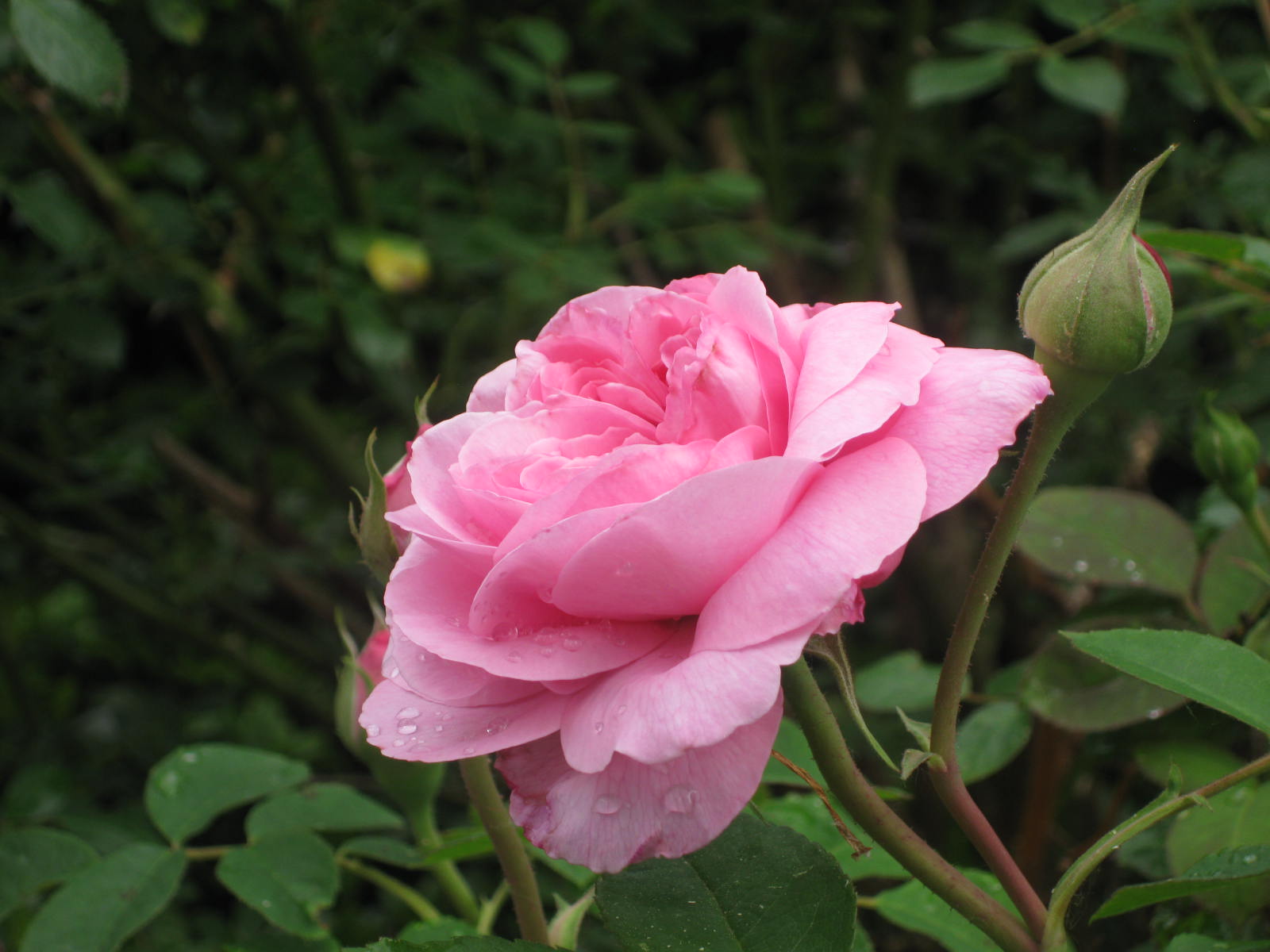 (Updated for 2019.) DRAT. While inspecting my roses the other day, I discovered that some of the shrubs (like ‘Mary Rose,’ above) are showing signs of “blackspot.” Details about this insidious fungal disease, and why — according to extensive research — a weekly spray of milk and water is the smartest way to control it:
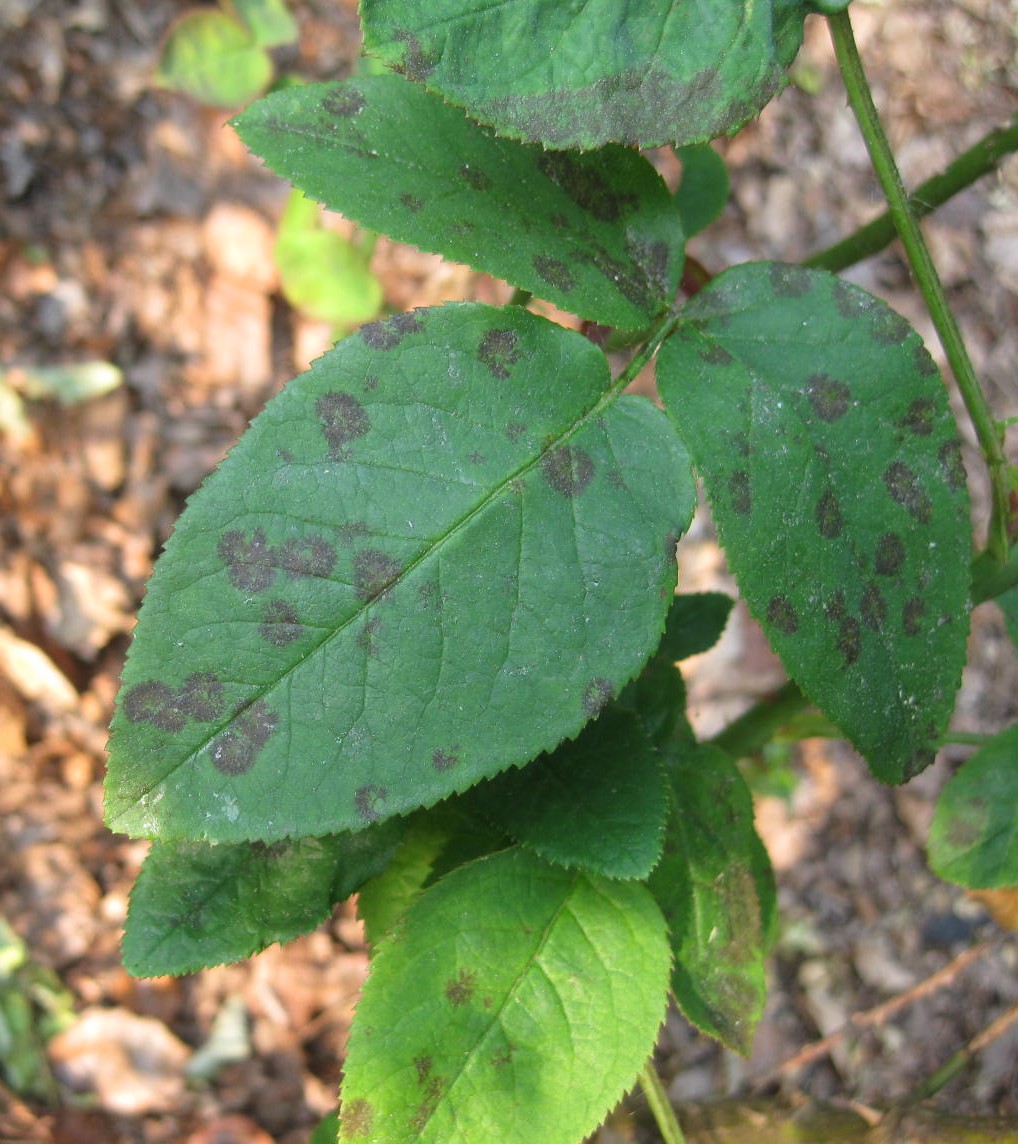 It’s not difficult to recognize blackspot, (Diplocarpon rosae). The fungus initially reveals itself as tiny black spots on foliage.
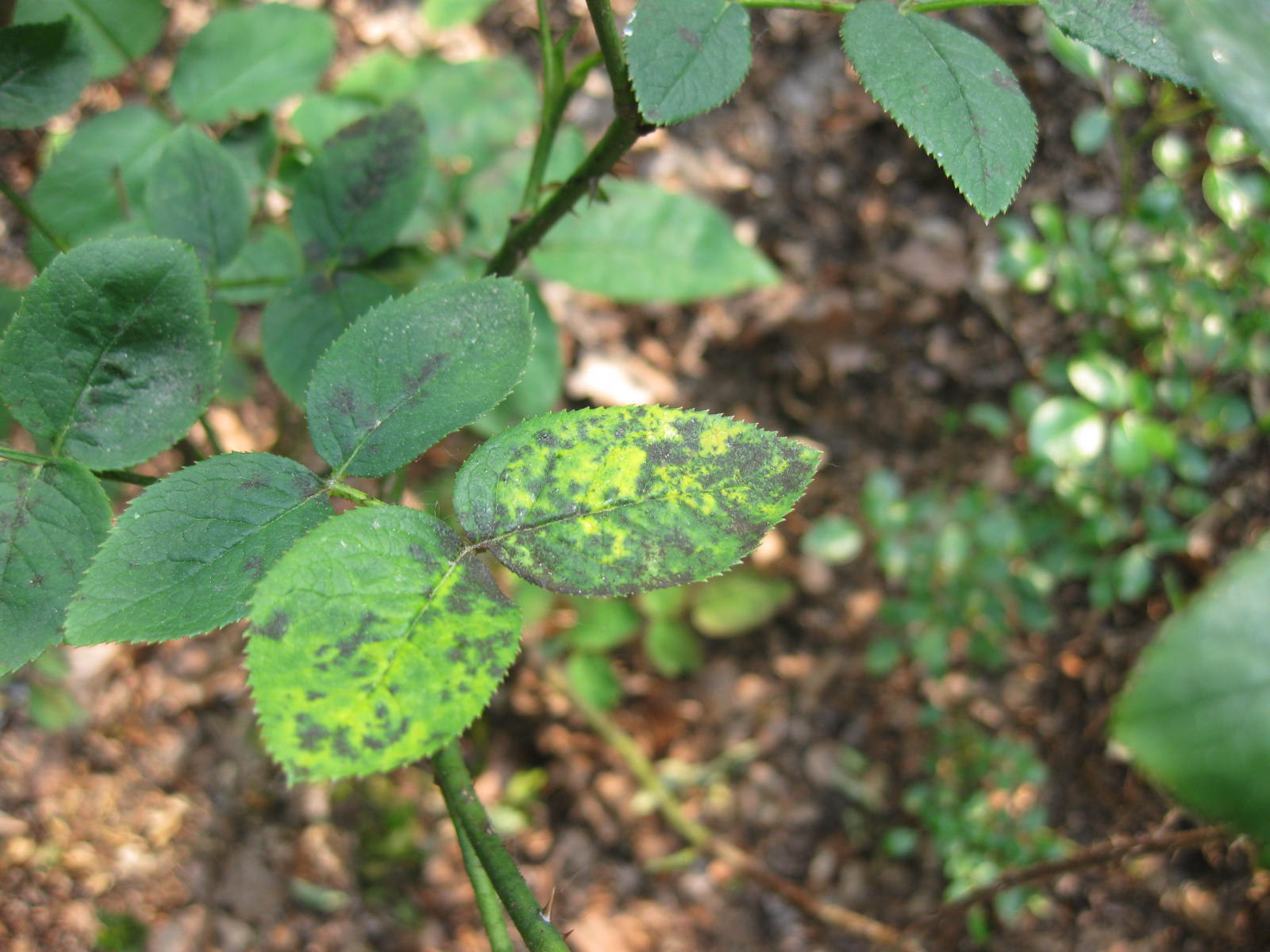 In very short order, the black spots become surrounded by yellow halos. These are not halos of the angelic sort, but the kind that indicate your rose is in trouble.
The infected leaves will eventually turn a sickening shade of yellow and then drop to the ground. And, if left untreated, the fungus will continue to attack other leaves on the shrub (young leaves are the most vulnerable). These, of course, will turn yellow and fall to the ground, too, until the shrub looks shockingly nude.
 Now, I’m not opposed to scantily-clad statues in my garden. But I like my roses fully clothed.
Treatment
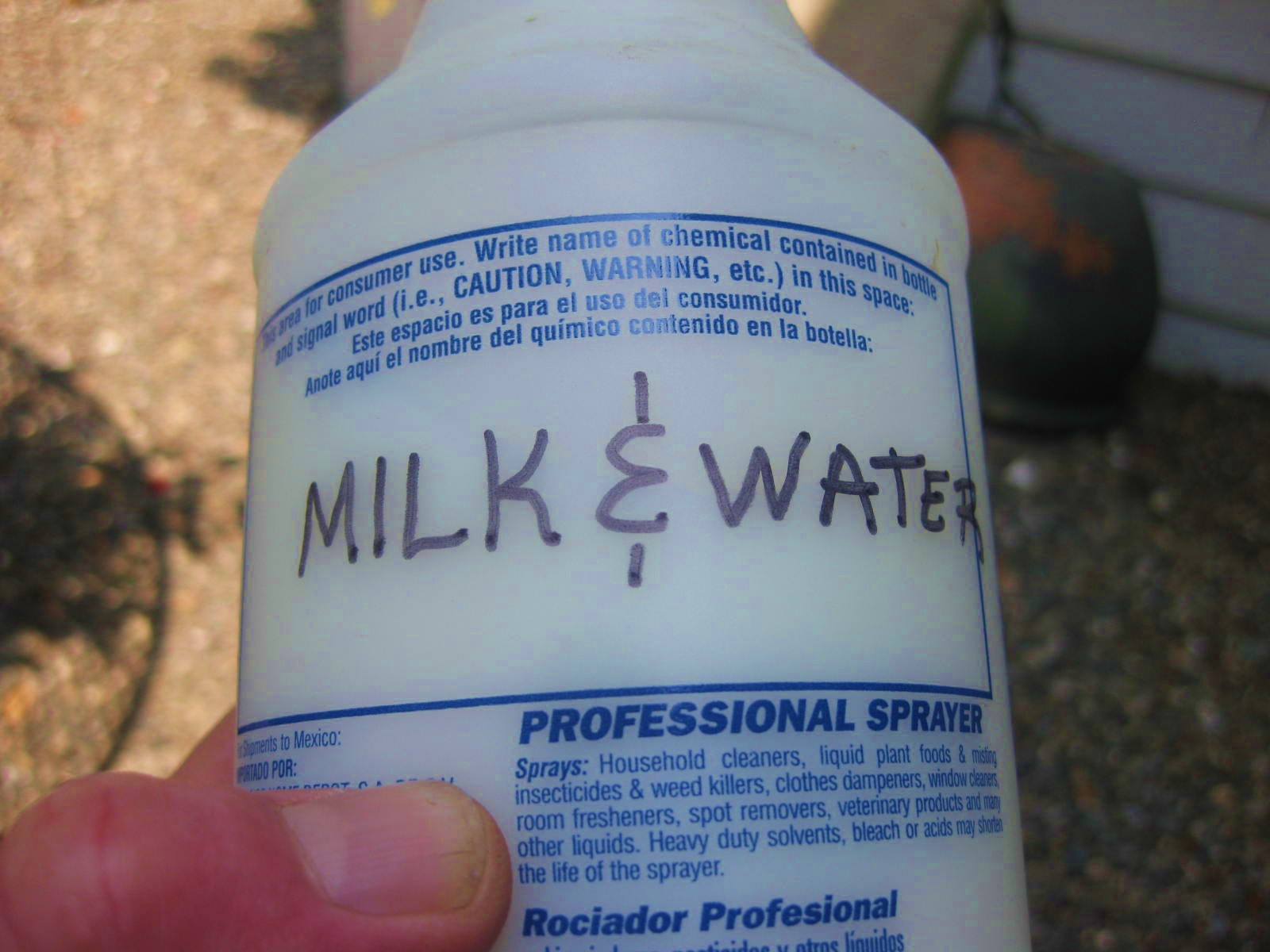
According to author and horticultural professor Jeff Gillman, who has conducted extensive research on blackspot remedies, a spray composed of one part milk and two parts water is the best answer to the disease. When applied weekly, the solution controls blackspot as well as any synthetic fungicide, including Chlorotalonil.
Why does milk work against blackspot? Well, nobody knows for sure. Gillman thinks it is the lactoferrin that milk contains. Lactoferrin helps to fight diseases in people.
Of course, Mr. Gillman is talking about cow’s milk here, any fat content you prefer. Rice, soy, and almond milk will have no affect on roses.
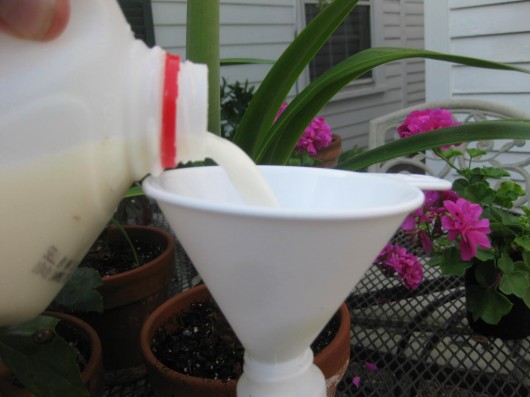 Spraying is work, but it isn’t hard work. Just be sure to wet both the top and bottom of leaves. Pick up any fallen leaves, too. Otherwise, the spores of the fungus can splash back onto the rose during a rain storm.
UPDATE: After spraying my roses weekly during the summers of 2012 through 2019, I discovered the method really works. Hallelujah!
ANOTHER UPDATE: Reader Jeff Powell (comment #130 below) shared this happy news: Good to hear that the 2/3 water and 1/3 milk solution works on blackspot. The solution also acts as a deer repellent according to the West Virginia Botanical Garden. I have used this combo for 2 years and can also testify to this working!!! Many of my friends, who live in more heavily deer infested areas, have also tried this….and all but 1 tell me that it works.
Try it!!!!
Don’t miss anything at A Garden for the House…sign up for Kevin’s weekly newsletter.
Related Posts:
The Organic Way to Beautiful Roses
Garden Design: From Parking Lot to Rose Garden
Creating a Raised Bed Garden

Sean says
We inherited eight rose bushes with our house. Instead of removing them I thought I would give my hand at raising them even though I have never gardened in my life. They are doing well, but then came the dreaded black spot. I was picking the infected leaves every day, but it persisted. After a long search online I came across the milk/water solution. I have to admit that it works, but you must do it weekly. I missed one week and I regretted that. The only down side to me, is that I get white spots on my roses from the milk but at least they are healthy!
Kevin Lee Jacobs says
Sean – Glad to hear this treatment worked for you. I made my first application yesterday evening. Although I noticed a slight trace of milk-residue on the leaves this morning, I can’t say the appearance bothers me. Better to have “white spot” than blackspot, right?
Rebecca says
I too have blackspot on 2 of my rose bushes. I plan on trying the milk spray (as soon as I can work it into my crowded schedule). Thanks for doing the research and finding an organic solution!
Cheryl says
So glad to have read this as my rose bushes have blackspot too! I’ve been picking off the leaves consistently. Does it matter what type of milk, whole milk or skim milk? I will be trying this remedy and hope it works!
Kevin Lee Jacobs says
Rebecca – That’s great!
Cheryl – I used whole milk. But according to Jeff Gillman, any kind of milk will work (except chocolate).
Terry says
I will have to try this as one of my roses gets the black spots every year. Also, one of my roses, a light pink one, gets brownish outer petals before it opens. Do you know what would cause that? I think the rose is a celsiana. I am thinking maybe to much dampness and not enough sun.
mada says
I did it this morning and the white spots make them look as if I had used solfto di rame and calce but instead of that, which I hardly know how it works, the dosis and the mix, and the fear that it burns them or if too diluted doesn’t work ……. evviva finger crossed ……. and I’ll tell that everybody thanks again
Kevin Lee Jacobs says
Terry – You are right. Too much moisture (either from overhead watering, abundant rainfall, or high humidity) can cause the edges of rose petals to turn brown.
mada – Glad you tried the milk and water solution. As I said earlier, better “whitespot” than blackspot!
Joan says
Would it work on the black spots on black eyed susans?
Kevin Lee Jacobs says
Joan – I know the milk-and-water solution works on blackspot and also powdery mildew, so maybe it will work on whatever fungus has attacked your black-eyed susan plants. Worth a try, anyway. Just remember you’ll have to spray weekly.
Mary says
Hi Kevin: I am new to your posts. You have a very nice site. So glad to have found it. I tried the milk/water routine last night, as my roses every year have blackspot. No matter how clean or how well I disinfect the area, it returns year after year. I also sprayed the bee balm, and even the bottom leaves of the Queen of the Prairie, as both of those have shown signs of blackspot. I’m looking forward to seeing positive results. *fingers crossed* Thanks for the tip!
Terry says
Oh I see you mentioned that this works on powdery mildew! I will be anxious to try this on my cucumbers and squashes, as every year they get that bad especially towards the end of summer. We have a lot of humidity where I am.
Anna Lapping says
I’ve tried it, and it didn’t work for me, but I live in NC where the humidity is quite high most of the time. I have better luck with bacillus subtilis spray once a week. It is also a biological control, so it won’t really cure, but will control fungus. It’s best to spray all plants weekly whether they show signs of fungus or not.
KimB says
I am going to try this on my roses and phlox. Need to get a new spray bottle first. I have been trying to avoid using chemicals now that my kids are playing in the garden and I have become more aware of the nastiness of many of those products.
Joanie says
Thanks for the tip! I’ll try the milk. I’ve been using fungicide and would rather stay organic if possible. Blackspot seems to have hit early this year due to the very rainy May in the Mid-Atlantic. I usually don’t have an issue this soon. It’s been an odd spring for roses here (Philadelphia) after the very mild winter.
As an aside, My Gallicas (Apothecary’s Rose and Rosa Mundi) never get blackspot, but do suffer from powdery mildew – the only roses in my garden which do. Odd. I’ll try the milk remedy on them as well.
KimH says
Thanks so much for this information! Last year my 2 roses had horrible black spot & I did nothing but this year, if it rears its ugly head I’ll be prepared!
jenna says
What about Neem oil? When would you use the milk solution versus Neem? I found that Neem works great for mildew issues, but love the idea of the cost savings of milk!
JEANNE ILLENYE says
Fantastic advice that I can’t wait to try! I also have neem oil which I’ll try. I have other plants besides roses that are having fungal issues such as my lilacs and boxwoods. Thanks for the tip! Milk & water is less costly and easier to mix than neem, so I’m off to the kitchen now! :o)
Melissa Horton says
Would this work on Loquats as well? My loquat leaves have black spots and have lost a lot of leaves. We thought it was blight and my husband has been spraying it with copper. Maybe
milk would be better.
Kathy, KY says
Thanks for the tip! I also inherited roses when I moved to a new house and while they are all in much better condition than when we moved here, I have noticed that I have 3 plants that seem prone to developing blackspot. I have used a fungacide/miticide drench hoping to stop it this year to no avail. With all the rain it is back in force. I hate to denude the bush removing all leaves with even a hint of spot on them, so I am GRATEFULL for something else to try.
Any suggestions to destroy cucumber beetles without harming the bees? They swarmed my roses last summer & are back in force already.
Thanks for so much helpful info!
Lela says
My grandmother, in the old days, used her dishpan water with the soap in it, and poured it over her roses to rid of mites and black spot.
Marcia Isman says
I will do it today! Is it best to use organic milk ( hormone, etc-free) or doesn’t it matter?
Marcia Isman says
I’ve never commented on this thread, why is it saying I did?
Terri H. says
Is it half milk and half water?
Han says
Will that work on the black powdery mildew on my jade tree?
Janet says
Does this work on Iris??
susieQ says
going to try this trick on my pear trees outside. what ever it is turns the leaves ugly and the fruit ugly as well and huge orange spores. hey, tried 2 drops of dish soap and water to a sprayer to get spittlle bugs off my plants and that sure worked with out cost too. Thanks again (spittle bugs make a foamy substance when eating plants)
ArtistryFarm says
first year here for black spot and it’s rampant. will use ArtistryFarm fresh goat milk and see what happens…THANKS!
Pam Doughty says
I am so glad that i got this helpful hint. I am getting ready to mix some up after this post. Thank you and I will let you know the outcome on my roses.
Pam
MarteyC says
I’m lactose intolerant and almost never haver milk on hand, so I use a Neem Oil spray. I apply it every other week, making sure to get all the leaf surfaces. It also works really well for downy and powdery mildew. An added bonus: it works well for roseslugs (the little green worms that skeletonize the leaves) too! It’s best to spray Neem early in the morning or in the evening to avoid spraying the bees.
Anne says
I’ll be doing your mlk and water spray this week, thank you for a healthy way to attack
Bill Schnippert says
You have the wrong roses. Get medieval roses that smell great and get very little fungal disease and are winter hardy. Try: Rosa centafolia; Tuscany rose(Rosa gallica v. Tuscany); or Apothecary rose(Rosa gallica v. Apothecary).
WS
Bonnie says
Recommend Reading Article by Mike McGrath, You Bet Your Garden Radio Show (PBS), on gardens alive web site. I use compost tea and compost on the ground to eliminate and control black spot on roses. Compost tea is magic.
http://www.gardensalive.com/article.asp?ai=458
Danielle says
I use whole milk (not diluted) on my zucchini, cucumber and pumpkin plants whenever powdery mildew strikes. Our climate (in Melbourne, Australia) is reasonably dry, and it works really well. A once a week application is great, but I’ll often spray twice a week to really make sure it works. It may be a slightly less effective treatment than store bought sprays….but I like the ‘no chemical’ approach.
Deanna says
I have spots on my peonies and impatients?
Joann says
I use a 1 to 3 mixture of milk and water as a foliar feed or for watering any outdoor plants. It is an amazing fertilizer. Plants become so healthy that they resist most attacks.
This past winter I began watering with the rinse water from milk containers. I milk a cow so there are many containers. My orchids were dazzling and for the first time ever I had a fuscia come through the winter with no aphid attack or leaf loss and it bloomed constantly.
This was of ccourse raw milk so there may be an enzymatic property.
Crystal says
Kevin, Thanks for the milk & water spray for roses. I have an arbor with 2 climbing rose bushes that always gets black spot. Hopefully, now I can truly enjoy walking through it to get to my perenial garden. Do you have a tip regarding “slugs”?? I have over 100 hostas in my garden and this year (with all the rain) my hostas look like it’s already September rather than June. I try to stay “green” in order to keep my bees happy, happy, happy and my 4 grandchildren supplied with honey, honey, honey!!!
I’m sooo happy to have found your website with all your tips on gardening, (I’ve trimmed my boxwood and are now trying to create more from the cuttings). Your recipes (the cinnamon rolls were dee-leesh and will be trying the doughnuts this weekend).
Please keep posting!!
nancy oden says
This would be great for commercial gardeners to know, since the world would be a much better place if poisonous fungicides and manmade pesticides were eliminated (all are derived from oil).
Perhaps large farms that routinely spray toxic fungicides could make use of this milk and water solution, as well, since pesticides are becoming much more expensive and we’re tired of having them contaminate our drinking water with poisons. Thanks for this.
Renae says
I, too, was happy to see that it will work on powdery mildew as I have two roses that just insist upon hosting the fungus. I am new to organic gardening and was disappointed that the commercial pesticides didn’t seem to be affecting these particular roses. As a result of discovering your sight, I have given up on my systemic methods for the sake of the local honey bees and had admitted defeat until now.
I have another question: some of my roses turn brown before they’ve ever opened and when they finally do open, the flowers are stunted and have a sickly color to them. What am I doing wrong?
🙂 Thank you much!
Antoniette says
The milk and water combo also works really well on powdery mildew on lilacs too! I had a horrible summer with that in 2011, and so far, 2012 looks a bit rainy as well so I’m going to be going back to the milk and water on the lilacs again!
Lori says
Will this work on lawn fungus?????
Barbara Dismukes says
Does this work on Hydrangeas?
George says
Sadly, I just found this advice. I have two roses that suffer from black spot every year. I diligently remove the spotted leaves, from the plant and ground. The bushes produce well, though the black spot is ever present. This year it appears my hydrangea, which neighbors the roses, has also caught the spot. I will be “milking” all three from now on. Thank you!
sallyanne says
Hi i have a garden full of roses and love them but this blackspot is driving me crazy!! Its mostly limited to 2 rose bushes that are beside each other, though i have found it on some of the other roses also now and then. I have been using bought stuff like resolva ect and it does work but the blackspot just keeps coming back and its getting expensive. I will definantly try this milk solution and let you know how i go. Thanks for the tip
sallyanne says
@Renae, sounds like you have harlequin beetle..they are black and orange. I just got rid of these nasty little critters thankfully. They get into the flower and turn them brown also they dont open properly. I used vinegar,dishwashing liquid and water spray. Seemed to work 🙂 tho you do need to spray them every few days.
David Wilson says
I know honey is also supposed to be great for fungus. I’m wondering if you mixed a little honey in with the milk if that would help or hinder??? I think I’ll try that as well!!
Thanks for the advice!
Virginia says
Every year I end up with sticks on my rosé bushes instead of leaves. Have been looking for a cure for black spot for a long time.Even master gardeners at a local garden show were no help. Boy do I have to enlighten them at this years show. Thanks so much.
kaylee says
I am showing roses at my county fair this year, and I have to say that his is very odd, but my plants are in need of something to get rid of the blackspot. I’ll give it a shot!
kaylee says
I just hope it works within 2 weeks…?
Sylvia Neal says
I once heard Martha Stewart say that she uses milk, with a little soda added for her rose spray.
Sally G says
I’ve poured this mix in the ground near my tomatoes monthly to keep them healthy. Will the spray also work on rhododendrons with black spot?
Yvonne says
I don’t keep very much fresh milk, could I use dry milk?
Lalita says
Thanks a lot for the tip, I saw this only now. My ice berg roses and Don Juan rose have this black spots. I will try this milk therapy. will this work for aphids too? My dahlia leaves are falling off.
Catherine Given says
Kevin,
What I needed was a Hori Hori and some good gardening gloves. What I had were rubber dish washing gloves and a yardsale trowel. My hand wasn’t happy about it, but I couldn’t seem to stop ripping out dandelions. Two hours later, I discovered a third-degree blister on the palm of my right hand!
Love your site!! What is the delicate greenery growing like a living frame inside the pretty triple windows?
Teresa says
I’m happy to find your site. My poor roses came from qvc and I’ve lost 3 and the remaining 3 have had black spot from day 1. I can not wait to try this method.
manor says
Thanks for sharing this wonderful idea with us.I am going to try this weekend.I got 25 rose plants and they all have this brown dot problem.I hope this will cure my plants.once again thank you so much.
Carol says
Will this work on rust too! Not on roses, but on Black Eyed Susans, I think its rust!
I guess it wouldn’t hurt to try…
Migdeliz says
Hello 🙂 thank you for sharing your method! I bought two rose bushes about 2 months ago. A week later, they developed black spots and I have been treating them with a commercial product. I’m glad I found an organic alternative and will give it a try. However, I would like to know for how long I should do the treatment and if there is a way of stopping this annoying fungus from coming back.
Rhoda says
I’ve just tried this and fingers crossed it will work. I’m really trying to stay organic in the treatment of blackspot on my roses. However, the odds are stacked against me as I live in Ireland and we get a lot of rain all year round!!
Denise says
I really need some advice on my roses. The actual roses look brown and burned when the blooms start to open up. The leaves then look half eaten. I don’t see aphids or any other bugs. Any ideas anyone?
Linda D says
My roses are also cursed with black spot, every year. I try everything I read.
So this time it was milk. First I gave my roses their favorite pick me up junk food,. (sugars, tea and tuna) Makes them re-leaf..
Then I mixed up the milk and sprayed. They were really shiny in the morning. Coated with the milk that had dried. The shiny coating is a sealant. No spores could spread on the leaf or blow. They were encased like varnished. I had sprayed the sick branches too, they were also sealed and shiny. The sun is harsh, humidity high here. They OK with that now. Perhaps its a sunscreen and keeps the humidy out? the sickest stiff fell off, but I didnt panic to get them away from the plants so fast.
It hasnt rained yet, so I will see. I imagine I will just need to spray them when they dry.
I am watching leafs that got spray just on top and spray only on the bottom and a control branch with no spray, to see how flexible I can be. I have some roses that are 20′ or more.
I noticed someone had spoken of losing new roses. Sold with too much wax, id guess. Just leave them. You never know. Once a few of my baby ones died but the root stock came back a year later. Root stock roses can be–well–umm–unexpected varieties?
mm2u says
Hi,
My newly planted roses (3 weeks since planted) seem to have succumbed to the dreaded blackspot and mildew .. all down to the incredibly hot weather we’re experiencing here in Fife just now I suspect … I’ve been looking for an organic spray so as not to harm any beneficial insects (such as ladybirds) that I’m trying to attract to my garden … will definitely be trying this out today .. will let you know how I get on 🙂
Thanks
mm2u
Susan L. Espersen says
I’m back with a new source of garden frustration! Not only do my roses suffer from blackspot, but the crab apple tree in my front yard does as well. This is my first Spring/Summer residing with this tree and it was sooooo beautiful in bloom! I hated to see the blossoms fall, but it leafed out fully and I thought, “You are still a lovely tree with which to share my front yard!” …………and then it happened. The leaves began to drop and I finally took time from fighting with my clay filled garden and squash beetles (yup, it’s me) and inspected the damage. Loads of yellow leaves with black spots were abandoning my tree fast enough to simulate October in New York state! I hate to resort to chemical warfare! Will the Milk and Water spray work on something on this large a scale? Also, how do I get it up there? I knew that I wasn’t the only one who didn’t like the humid weather that has taken up residence in WNY this summer!
Susan
Kevin Lee Jacobs says
Hi Susan – Sounds like your crabapple is the victim of “apple scab” — a common fungal ailment in humid areas (like mine). It’s especially prevalent among older apple tree varieties. New varieties are scab-resistant. Though unsightly, the fungus won’t kill your tree. Clean up and destroy all affected leaves to avoid further spreading. Then, in spring, just as new leaves appear, spray the tree with the milk/water solution (or some other fungicide) every week or so. Yes, what a job. Not sure how you will reach the upper portion of your large tree, short of a tall ladder (dangerous!) or a mechanical lift (expensive!).
Teresa Smith says
Does black spot cause the rose petals to turn brown or some of the buds not to open?
Kevin Lee Jacobs says
Hi Teresa – Excessive rain, overhead watering from a sprinkler, and high humidity in the air can all lead to the rotting of rose buds. There is little one can do about the condition except to avoid overhead watering, and to hope to for dry, sunny weather.
m.rajavi says
i have 35 rose plants i found black spots on the leaves of some plants . I am searching for the remedy. Now i got the tips. from tomorrow i will try. Thank u
Erma Yoder says
Will this work on blight for tomatoes or do you have another cure. I use a copper soap but it takes diligence.
Naomi Shelton says
My roses have innumerable holes in their leaves. What am I dealing with here? I wish I could send you a picture. The new leaves will be ok, but then they will start having holes, too. Could the milk and water treatment work for them, do you thlnk?
Julie B says
I don’t know how I missed seeing this whe it first appeared but I’m glad to have stumbled across it now, Kevin.
My antique roses don’t get blackspot but the one to which I have the strongest sentimental attachment suffers from it every year no matter how I treat it. I plan to try the milk spray this week.
It will be interesting to see how the deer respond to milk- flavoured leaves…
Cindy Marino says
Does this milk solution work on Peonies? All my leaves have a grayish haze on them!! They look horrible. I only have one rose buse but I am definately going to try this milk solutions. Thanks for the tip
Layne says
Was having trouble with black spot on the roses…hate using chemicals. Use white vinegar to control weeds in our gravel driveway. Thought about black spot and the spores. Well, I sprayed the mulch surrounding the rose bushes with a light misting of vinegar…seems to have helped control the blight by killing the spores. Repeated after rain but only once a week. Will keep you posted.
Tobi says
I’m taking your advice. I sprayed my roses this morning with the milk/water mixture. I’ll do it every Monday morning. Thanks!
Amanda says
I’ve loved roses since I was a little girl, but not until this summer I started to grow them. I bought 5 rose bushes ealier this summer and they all suffer from black spots, although they all bloom beautifully. I constantly picking the infected leaves and water them at the roots but it didn’t stop the disease. Yesterday I sprayed them with this milk mix and this morning I was surprised! All the leaves are looking beautiful and healthy, with shine! and I didn’t not see any white marks. I am so grateful that I found this website, I ordered 15 more hybrid tea roses and I will keep on spraying!
PattyM says
I only have one rosebush, and it DOES have blackspot. I was going to pull the whole thing out this Fall, but I think I will leave it and try the milk spray in the Spring. Fingers crossed!!
Cathy says
Does it matter on the milk?? whole / 2%/ or skim milk????
Shirley A. Ney says
I have 1 rose brush and it has black spots. In the spring I will try this. I noticed that the roses in the next yard has them to so I’ll spray his as well. Thank you for this information.
Susan says
What kind of milk and what is the ratio of milk and water? It’s winter here, but will try in early spring.
Allan lawrence says
IT WORKS: I have only been growing roses for seven months. So yes I am very new at the task.
One thing I discovered real quick is the humidity in Sydney plays he’ll with your roses being Blackspot. I have been spraying with a top line rose spray as per the label.Two sprays and the bottle was used up at $10- $13 a bottle.
I went onto this page and read about milk and water……it works. I spray one every week and have been doing this for four weeks now,but the change began in three day from when I started.
Thanh you so much for your help.
Best regards Allan L
Van says
Hello! I’ve been following your blog for some time now and
finally got the bravery to go ahead and give you a shout out from
Houston Texas! Just wanted to tell you keep up the great work!
Kevin Lee Jacobs says
Hi Van – Nice to “see” you!
Elizabeth says
I use a baking soda mixture with great results. Here’s the blurb from the site where I got the recipe:
“There are a few home remedies that have met with some success and are worth trying, especially for those that really do prefer organic garden methods. One is a solution made with baking soda: dissolve 1 teaspoon baking soda in a quart of water, add a few drops of liquid soap to the mix to help it cling better to the foliage, spray infected plants thoroughly. Another unusual remedy for fighting fungal diseases is manure tea. This formulation fights blackspot, as well as mildew and rust, while providing foliar nutrition. Place one gallon of well-composted manure in a 5-gallon bucket and fill with water. Stir the mixture well and let sit in a warm place for three days. Strain the mixture through a cheesecloth or mesh and use the resulting tea to spray disease affected plants (the solids left behind can be applied around the base of the plants as added fertilizer).” rosemagazine dot com/articles02/pages/blackspot.asp
K. R. says
Kevin Lee,
I, by chance, found your website today. (4-07-2104) I live in Southern Arizona and there is hardly any humidity here except for the monsoon season and I have black spot galore! Not to mention aphids. The last two days, I have planted Wisconsin winter onions (They are quite strong) around all eleven of my rose bushes. I used to live in Colorado and garlic plants by my roses there, kept the aphids in check. I hope the onion sets will do the same here in Arizona. I like to use rose petals in salads and I make tea out of them as well. The Peace rose makes excellent tea and my double delight makes what I consider to be the best tea ever. Since I cannot use any product with chemicals in it, because I eat the rose petals, I will try your milk/water solution tomorrow. You have a wonderful site here and the information is absolutely great. Thank you very much.
I will report back in a week to ten days as to what my results are.
Kind regards,
K. R.
Peggy Herron says
Thanks Kevin ! Am going to do the spaying the only part that looks tough is the weekly scheduling . I an grateful I know linger have thirty David Austin’s to take care of. They are fine after the winter I just left that job. I still miss my big beauties . It is great to see your gardens finally free of snow. I am still wearing my winter jacket but the cool dry weather is just what my tulips need to last a little longer. Great season for bulbs but hard on this cold gardener.
JJP says
Do you think this will work on black spot on my peonies?
Kathy says
Hi and thank you for the advice.
I am completely green – (innocent) where gardening is concerned and have two rose bushes covered in black spot.
Should I remove all the affected leaves before spraying with the milk mixture or leave them on the bush?
Thank you.
Rachel Clark says
I am definitely going to try this milk spray! I live in the San Francisco Bay Area (Berkeley) and all my roses are plagued with blackspot. Usually, I just wait till it’s too ugly and then strip all the leaves, but that is a royal pain and not all that effective. If your advice works here, it can work anywhere. I’ll let you know.
Patty Richards says
Good Morning—Patty here! I am taking care of 50 roses for my 84 year old mother and the milk is working its magic on the roses!! Thank you for the organic pest and fungicide solution! Now – “What do you feed the roses”? When and how many times during the blooming period?
Thank you for all your help!!
Dana Sheridan says
I am SO glad I saw your post! I am going to spray my roses with the milk & water solution first thing tomorrow. I wanted to treat my roses organically this year, so I sprayed mucofol on them in early spring to help boost their health. But unfortunately, the spots have returned. I can’t wait to try the milk & water and hopefully safe my roses in a healthy way! Thank you! Dana
Debi C says
OMG I have this problem with my roses: I am definitely going to try this. I also did not know about overhead watering. I am going to have to have my husband help me readjust the sprinklers. Any suggestions for weeds that grow up between the cracks in the pavement? I’ve sprayed them with white vinegar but they are still there. Thank you so much for your awesome blog site. I love reading your posts and looking at all your fun pictures.
Delores Short says
My roses have black also–I’ trying this today.!!
Thanks so much
Susan Davis of Southern Touch Farm says
I truly enjoy your posts. Thanks so much for nuggets of info and other variety of stories and recipes:-). I have loads of raw dairy goat milk as well as raw cow milk from our miniature jersey cows. I bet a combo of both products will work wonders to eradicate the first signs of black spot we have noted on our beautiful David Austin roses! Heading now to find that spray bottle I saw a week or two ago…..thanks again!
Beth P says
Hi Kevin, I’m totally new to roses so this article has been an eye opener. Last season my husband purchased 8 rose bushes for me and they all got rose spot. I prefer using as few heavy duty chemicals as possible so i will be trying this solution out this year. Thanks as always for the inspiration and great advice!
Hugs,
Beth P
Harrisville, NH
Rachel says
Thank you so very much! I enjoy reading your blog and it has helped me quite a bit with my garden. I have black spot on my rose bushes and can’t wait to try this. I was about to go to our favorite local nursery and talk to them and show them the leaves on my plant. You are fantastic! Thanks again. I’ll let you know how it goes.
Annie Hogsett says
I’m definitely going to try this. One questions, moderately — well probably totally — unrelated: If I’m suppressing weed growth with newspaper, do I need to weed before laying down the paper or can I put it down right on top? Thanks!
poulsbogardenlady says
Great timing Kevin! I moved my Bonica shrub roses last winter to give them more sun and they flowered last week but now I have blacksmith on one. Tomorrow I am going to try your recipe, so thanks!
Rita says
New Zealand grape growers have used this solution for many years and yes, it works!
In spring I mix up a big bottle and head out to the gardens and I spray everything down with this solution – you just never know when any type of fungus/blackspot will appear and this sure helps. I haven’t had blackspot on anything in a couple of decades. I think that spraying first thing in spring time strengthens the plants – probably systemic? I use skim milk and don’t have a problem with white residue. I only spray my plants a couple of times in spring. Try it – you’ll like it!
Rita says
New Zealand grape growers have used this solution for many years and yes, it works!
In spring I mix up a big bottle and head out to the gardens and I spray everything down with this solution – you just never know when any type of fungus/blackspot will appear and this sure helps. I haven’t had blackspot on anything in a couple of decades. I think that spraying first thing in spring time strengthens the plants – probably systemic? I use skim milk and don’t have a problem with white residue. I only spray my plants a couple of times in spring. Also – using this I don’t get powdery mildew either! If I forget and see the first sign of p.mildew I spray down the plants and soil immediately and it stops them in their tracks! Try it – you’ll like it!
toma says
Hi, Kevin! I have long and happy to read your site. My roses every summer too sick blackspot. With this fight is difficult, but I hope my recommendations will help your roses stay healthy. I’m from Siberia. All the best, Kevin!
Beverly, zone 6, eastern PA says
Nearly every one of my 7 roses is an antique, grown from a cemetery cutting. They only bloom once but are remarkably hardy and disease free. I like the organic treatment, though!
Peggy Herron says
Hi Kevin,
I have been enjoying Enlish roses for a week and another week to go. No Knock Out roses here ,they like their roses tall with fat sexy fragrant flowers. I am rose heaven . They have a bit of Black Spot here too but even heaven is not perfect. I will start Kevin’s milk spray when we get back.
Lulu says
I’m flabbergasted reading about people saying they don’t drink milk or have milk on hand, what can I do or use, dry or powder or…..you crazy people, go to the store and buy some. It’s not that difficult!! Gees!!
Shannon says
Blackspot on roses and whiskers on kittens,
Sorry, Kevin.
Your posts are delightful.
Helen says
Hi Kevin,
I took care of the pests that attacked the roses, but the black spot made very uneasy. Thank you so much for the milk and water advice. Roses are one of my favorite flowers and I was ready to give up on them and move on to another plant. This suggestion is something I can easily follow.
Thank you again!
Beginner gardener,
Helen
K. Hussey says
Hi thanks for the milk remedy.What do i do for bumps on my tomatoe stalks .They usually occur around august .Could it be aphids?
badger gardener says
I am finally taking your advice and using the milk spray this year. I’m trying it on my phlox too.
myrtle miller says
I’m just speculating but maybe the black spots are caused when the soil is disturbed by too much water that interferes with the acid content of the soil and milk contains lactic acid so maybe this is why it helps.
Jacki says
I too inherited a few rose bushes and I’m headed out the door right this minute to treat with the milk and water. Thanks!!!!
Lyne Barnes says
I have never experienced black spot, in the climate I live in. It is very dry here so we rarely have the issue, but I am going to save this idea and if I ever see it I will know what to do. I love roses but living in zone 3 has it challenges in getting them to grow. I have been fairly successful, but I will admit I do baby them a lot. I also feed my roses with banana peal each spring. I will save banana peals cut up in the freezer and each spring my roses get a feeding of banana peel around the root area of the rose. I work it into the soil with a little peat moss to help hold moisture in the soil and I have beautiful roses all summer. I will send you a picture as soon as they start to bloom. Usually in mid to late July.
Cheers Lyne
Ana says
Oh this is very good news! Yes, I have some trouble spots, not only on roses but also other plants. I have had this for years. I have tried a few very strong chemical systemic products but they didn’t work. I don’t use chemicals anymore. This has been one of those frustrating days that everyone has. You know, 2 1/2 hour wait for a 3 minute doctor visit, son needs help with chemistry and man I did not remember how hard that stuff is and my little dog won’t eat and I don’t know why yet-probably grass consumption. So this is great news and I will try it to tomorrow if it doesn’t rain. Thank you!
jan bee says
I have been using this remedy for a long time and it works well for my roses. To the milk mixture I add a few drops of liquid dishwashing soap which helps the mx adhere to the leaves.
Jan bee
Jim Lambert says
Did you know if you plant Garlic in between each rose bush you won’t get blackspot – here in the soggy Pacific Northwest it works like a charm – this is an old remedy my grandmother told me about and it really works – I don’t know why- but I’m sure there is some reason –
Garden Magic 🙂
check here how to hack facebook says
Simply because Facebook or myspace is a brand new
occurrence, there aren’t any clear-cut solutions to crack
that. Capturing the template and doing a playback is a security risk, and storing your templates on multiple devices and
sites increases the probability of theft.
Some have a ‘secret question’ you have to answer if you cannot
remember your username or password.
click here says
I love what you guys are usually up too. This kind of clever work and reporting!
Keep up the superb works guys I’ve you guys to blogroll.
Dr Renji says
Hi
Thanks for the suggestion of milk/ water treatment for black spots. My rose bushes were having them and I am gonna try your method . Update you once I succeed .
a says
Very nice article, totally what I needed.
Peggy says
Thanks so much for this solution!! Went out today to buy this years supply of concentrate for spraying my roses for disease only to find it isn’t made anymore! How crazy is that? Also, I have a disease in my soil (forget the name right off hand) that killed my 55 yr old maple; roses don’t do as well as they could, can’t grow tomatoes at all anymore. Had researched the web when I lost the tree & found a great big long list of plants that either don’t do well or don’t survive this disease. My solution? Spray the soil with apple cider vinegar (vinegar cleans everything); this can only be done when the garden is dormant for areas where you have rose, flower or vegetable beds as the vinegar in the strength needed will kill plant growth. Then spray with Dial soap solution. Yes, Dial is antibiotic so hopefully it will work. This is my 1st yr.
Vikki says
I know apples are in the same family as roses and the leaves on our apple trees have tis balck spot will this work for them too?
Sharon Harvey says
Hi..I get Black spot on my Roses…I have had it before …and have had it again this year. Being an amateur gardener I had seen it obviously but didn’t know what to do about it. I decided to educate myself and research the problem on the internet. Your site was one that came to my attention and decide to try the method you described.
I have indeed tried it and it appears to have worked…so I am rather proud and pleased with myself over educating myself over this awful disease and successfully seemed to have conquered it and my Roses are now blooming again :-)).
I am now going to pass this information onto the other amateur gardeners in the facebook group I co run so they can also learn about this invaluable information :-))
Thank you for the information.
Sharon
Trudy says
Hi Kevin…I googled for a home remedy solution…I have underground irrigation…so leaving my garden for a few days didn’t worry me. However I came home to one of my rose bushes having a tremendous amount of black spot…leaves nearly gone around the bottom..still flowering but looks terrible…do I cut it right back at this point or will milk and water resurrect it? Thanks so much…
Kevin Lee Jacobs says
Hi Trudy – I’d cut the shrub back, and pick up all the leaves which have dropped to the ground. When new growth appears, start the weekly milk/water routine. Your rose shrub will be happy — and so will you!
Mabel says
Will this solution work on the leaves of my grafted mango tree. I live in the tropic
Trudy says
Thanks Kevin…I will do that…all of my other rose bushes are doing well so I will start spraying them weekly…cheers! 🙂
Jennifer H says
I do have black spot! I’m going to give the milk and water solution a try. I will report back on the progress!
carol Jane says
I doon’t have black spots on my roses but I do have a ton of tiny holes on the leaves. Would that be insects?
Dorothy Lake says
You started off by saying, The other day you noticed Black spot on your roses but later saying you spray your roses ever Monday, odd that, Because if this method was really effective having being sprayed with this solution every Monday then surely the Black spot would not have appeared, but in your tale it has appeared, So surely that is proof that this method of yours does not work. My tip for you is: Milk is not for roses but for a cup of rosy lee.
Mary Ellen says
I recently bought four Blue Girl roses. They were doing fine and then came the hot humid days of August. Yesterday I tried your milk and water treatment. I plan on doing it twice a week. I know it will work. Milk is good for everything, I come from Wisconsin 🙂
Sharon says
Will a solution of powdered milk and water work just as well? Milk is expensive in my area.
WillieKing Bending says
Thank you. I am going to do this.
JeffPowell says
Good to hear that the 2/3 water and 1/3 milk solution works on blackspot.
The solution also acts as a deer repellent according to the West Virginia Botanical Garden.
I have used this combo for 2 years and can also testify to this working!!!
Many of my friends, who live in more heavily deer infested areas, have also tried this….and all but 1 tell me that it works.
Try it!!!!
Kevin Lee Jacobs says
Hi Jeff Powell — The solution is a deer-repellant, too? Good to know!
Emily says
how do you spray the underside of the rose leaves without getting scratched up? so far I am only able to spray the top surface on most of the leaves. Is it necessary to remove every single infected leaf or will the infected leaves become healthy after repeated milk treatments?
+Linda says
I spray my roses very successfully with a combination of Powdered milk, garlic granules and fresh chopped up chilli mixed with water and a small amount of detergent and spray, it keeps away the aphids
Ruth says
The milk spray works well when done in bright light..so mornings would work. Also i heard its only cow milk that works.
Alasdair Dowling says
I have read pretty well all the comments on the treatment of roses. I have close on 400 bushes growing in the North of Scotland in sometimes very adverse wet weather conditions. I grow a range of around 180 different varieties, some of which are for flower shows. It is interesting to note the varyng effects to different varieties a and how they react. I find all the comments so interesting. One issue I feel is somewhat overlooked and that is a belief that any one method taken isolation simply doesn’t work. It begins with good hygiene in the autumn. I spray the ground and bushes with diluted Jeyes fluid and thoroughly clear the ground. Following trials in Denmark a mixture of skimmed milk and water (50-50) came out ahead of the chemical products. As a member of the Rose Society at that time they asked for volunteers to undertake the programme. I have pretty well used it for many years. It does, however, involve considerably more work. It didn’t seem to have much effect on mildew and rust (or greenfly!) which meant additional spraying had to be done. But it sure cleared the blackspot! If you are prepared to carry out the 14 day cycle of spraying (and find enough dry days to do it!) you will find the leaves take on a shiny wax like appearance. It has to be remembered whatever method is used you must organise an overall system and don’t look to find one solution to solve all the problems. If however, some one discovers a miracle one-off solution letusknow all know. Happy gardening everyone.
Abhishek says
I am from India and I planted three rose plants but at first one of them started to blacken. The stems started blackening and nothing worked. The plant died. Now the second plant started blackening from stem.
What should I do to save my plant?
Judi says
Thank you Kevin, I want to grow roses but black spot is a problem here in AL I am going to try this out. Also the types of rose. Love your blog.
Trudi says
Wow over 137 happier rose gardeners ! You have started a revolution haha .I am going to start spraying mine BEFORE i get andy fungal issues. THANKS KeVin
Heather Perez says
It sounds like you have mites or leafhoppers. I honestly suspect mites I would treat with a pesticide that has those listed insect. Make Sur especially it states it kills and protects from spider mites as roses are very likely to get mites. Diatomaceous earth is best to put at base of plant and keep all leaves off of the ground (by cutting back the plant) or container soil and actual container.
Stacey says
I have 2 rose bushes in a raised bed and there is a slight pitch to the bed. the rose that is higher might have 10 leaves left on it and they have black spot. Will it come back if I use the milk or do I trash and start over? I have been using “Daconil” spray. I remove the leaves from around the plant but one thing that I have not done and I think I should have because I just noticed that the other rose that is absolutely beautiful has a couple of infected leaves, I’m not treating the soil. and with that pitch, would black spot wash down to my other rose?
Milking tomorrow!!!
frank Stannard says
Milk to water – one third mix and a couple drops of dish soap (promotes adhesion) and diatamatious (sic – pool filter media) around the base (keeps crawleys from climbing up) seems to be the high points after reading for a half hour of pages and pages of comments.
sheila henkin says
I have found that brownish outer petals and general Brown petal is caused by thrips
Lovin my Flowers says
Hi
Thank you as I wasn’t wild about spraying anything chemical in my gardens.
FYI – We had Zuchinni and Squash last year which got mold on the leaves. The milk treatment worked amazing for that – plants recovered and went back to producing abundantly :0)
Tami True says
Hello – I am about to try the milk solution on my roses suffering from powdery mildew but would love to get some advice on thrips control/eradication without harmful chemicals or a prohibitive expense. I have some roses with P.M., a couple with Thrips and several very healthy roses all right next to each other in a line. All were purchased & planted by me a year and a half ago. Unfortunately, at the time, I had no concept that some roses were disease and pest resistant etc. and naively just picked the varieties I thought were the Most beautiful. Ugh! I did read that Bayer All in One works for Thrips, mildew, and dozens of other problems which sounds like a dream BUT I really do not want to harm the pollinators or anyone/anything else… Thank you for any direction you can give me!!!!
M J C says
I suspect you mean to say it’s an insidious disease, not an insipdid disease.
M J C says
If I could type, that would read insipid.
Sylvia says
I have just sprayed my roses with Hortico black spot and rust spray and more black spot and rust is appearing and I have tried Brunnings spray and nothing works if it doesnt stop I will have to9 have my roses extracted from the ground.
Azizah says
Hello I am from Malaysia the climate here is very hot and high humidity .I have been spending much for my rose gardening…I got so stressed about this black spot.first thing in the morning when I woke up,I have to pluck all the affected leaves and again this make me so stressed.I read this article..I try spraying 1 milk ..2 water at my roses…my God,BELIVE IT OR NOT, IT WORKS LIKE MAGIC…no more yellow leaves and no more black spot…I am so happy to find this article..TRY THIS IT WORKS
Karlynn says
I have used this method also, but I was using 2% at home and whole milk at work. While both grades worked, I found that the whole milk did a better job at getting rid of the fungus faster. I now only use whole milk, and I agree that white spots are better than the black spots, cause you don’t lose your leaves with the white spots!
Scarlette says
Is it necessary to spray roses with the milk/water solution weekly – forever? I am hoping that once it is under control, I can just be more careful about how I water my plants, etc. (Rose hygiene).
C. L. says
I’d rather try milk than nasty chemicals to get rid of blackspot, but may add some natural green food coloring so the leaves won’t have white spots.
S. Barton says
I am wondering if this will work for our rose bushes in North East Texas? They just look pitiful!
June says
I just spray my 17 roses and peonies yesterday with 1/3 milk mixed with 2/3 water. let’s see what happen? After done, I do see their leaves shinny under the sun.
Craig Ayliffe says
Wonderful tip! Amusing to read the other comments too. I believe Kevin said any cows milk (whole, 2%, 1% 0% will do and the ratio is as Kevin said in the beginning: One part milk to 2 parts water, and you know, a $9.99 sprayer from the big box store. Don’t use a windex bottle. Go to the stores and buy both. Water comes out of the tap in the kitchen.
By the way, I have a kitty cat with a bad cough, any advice? Any prayer cloths? (hah hah). Meow!
love your column.
Craig and Alberto
Aussie Gwendoline says
I wonder if it works as a repellant for kangaroos as well as deer!!
lee says
Great post! I’ve tried milk for powdery mildew and it works! Please provide the formula for “dry milk” if you have it handy. Thanks so much! 🙂
Irene Horner says
I live in Ontario, Canada….wondering when to start spraying…what time of the year ?
Janet says
Is this in 2/3 cup of water and 1/3 cups of milk ?
George Buie says
I use a one-gallon sprayer. How much milk would I need to put in the sprayer to mix with the water to treat black spot? Thanks very much for your help…
Kevin Lee Jacobs says
Hi George – Ratio is one part milk, two parts water. You will have to do a little math here for your gallon sprayer, but just think of the solution as 1 cup milk and 2 cups of water. Hope that helps!
M says
Now if it would also deter squirrels as well as all of the other wonderful things it does, that would be awesome!
JOHN BEAUMONT says
Does it the amount of fat content in the milk matter ie full fat, half fat or skinny milk?
Maryann farrell says
Hi, I’m assuming the milk is safe for all pollinators. I invite bees and several types of butterflies in my garden and I also raise monarchs in my garden. So I have to be extremely careful. I was wondering if the aspirin mix would be safe for all pollinators as well as my monarch cats? I don’t want to harm or kill what I’m trying to save.
Thank you
Leah says
I used 10 drops of tea tree oil in 1/4 glass of water, and it worked on 1st try.
I bought fungicides before that, but they would just burn my plant plus did not get rid of black spots. They would kill all insects in the ground and around the bush which is not what I wanted. It also made my plan very sick!
The tea tree oil drops mixed with water did the trick because tea tree oil is a well known for its anti-bacterial and anti-fungal properties.
I watered only leaves and only tops of them, but entire plant completely recovered from black spots. Plus it looks really healthier now, looks like it liked the natural oil stuff.
Bobbie says
Hi Kevin. Does this milk solution help fight aphids on roses? I use a store bought insecticide that is, I think, non toxic to fight the aphids. Just wondered if I could switch to the milk solution.
Cissy says
I don’t know if you’ll get this or I’ll get replies since these posts are about 6 years old but I’d like to know if it will work for gardenias. The branches are turning black as well as the leaves. Thanks to anyone who answers!
Kevin Lee Jacobs says
Hi Cissy – From what I’ve read, black leaves/stems on gardenias are usually the result of a white fly infestation. More details here: Gardenia Leaves Turning Black
AG says
Will this work on rust spots too?
Karen Mary says
So glad to hear about this safe solution! My new roses look like they’re coming down with this malady, so I’ll give it a try today. Thanks for the tip! Love your rose photos!
Kevin Lee Jacobs says
Hi AG – I don’t know if the milk/water solution will combat rust spots. But it definitely works for blackspot!
Hi Karen – So glad you liked the photos. Good luck with your roses!
Cheryl Wolfe says
I plan to try this. The lady that commented on roses turning brown could have thrips. I enjoy your blog.
DA Bennett says
Thank you for keeping all of your posts on line. This past week, we tried your recipe for cleaning windows. We have a sunporch full of those windows with many, many individual small, horizontal panes that wind out to allow air to come through. They might be lovely in Florida, but we’re in Colorado! In any case, cleaning them, is a nightmare. With your window cleaning recipe and a very slightly scrubby sponge, we made quicker work of a difficult task. The isopropyl alcohol, water, and sudsy ammonia solution is brilliant! Thank you.
Linda Caron says
Just found your article in time to treat my roses! Thanks for the information.
Dorothy says
I was so happy to read about the milk that has helped black and yellow spots on my roses but I am 78 years old and I love roses but when the plant becomes full of yellow and black spots available makes my heart break thank you I will be trying this solution
Dee says
Awesome..I use a fermented buttermilk solution on plants..I guess that would work too if sprayed on leaves instead of on soil.
Also is it better to use this milk water mix at night or in morning before sun is out or maybe in morning sunlight? Does it make difference in time of day? I’m in Atlanta
Kevin Lee Jacobs says
Hi Dee – I’ve applied the milk/water solution at various times of the day: morning, afternoon, early evening.
Lynn Ballantine says
I’m not sure what is wrong with my roses. One of them has spots on the leaves as well as on the roses. There’s a lot more detail I could provide but I guess the bottom line is this: does a milk wash help with other fungi or pests?
Leah Allen says
doesnt the milk curdle and sour in this heat? Should it be refrigerated?
Awesome site and thanks!!
Teresa says
Hello I just used the milk spray last evening. Today the air is dry but the sun is fierce. All the leaves have shiny coating and I’m wondering if they’re going to then burn? My bushes are very young new plants that got who knows what (guessing black spot) and I’ve been battling it for weeks now. Used a fungicide that burnt the new growth and some of the mature leaves. I just can’t win.
Kevin Lee Jacobs says
Hi Teresa – In my vast and long experience, milk is harmless to rose leaves. Good luck with your garden!